Amonkhet (plane)
Amonkhet is an Ancient Egypt-inspired plane overtaken and once ruled by Nicol Bolas.
Description
Amonkhet has two suns, a round moon, and milk-white stars that form constellations in the night sky. After Nicol Bolas's trespass, the suns blanketed the plane in perpetual daylight without nights, with the Second Sun gradually approaching Bolas's Horn Monument. The people believed that when it appeared between the horns, the God-Pharaoh would reveal himself to them. After the Hour of Devastation, the Second Sun returned to its normal cycle, restoring the plane's nights.
Amonkhet's leylines are weaker than other planes, pulsing like the veins of a dying animal. When given the chance to examine the leylines within Naktamun, Nissa describes them as "stunted"; not only are they artificially concentrated behind the Hekma, but the leylines of Naktamun are corrupted by a dark, virulent strain that subtly weaves itself through the leylines.
Much of Amonkhet is covered in desert and ruins, which are known to the inhabitants as the Broken Lands. The only known settlement was the city of Naktamun, where the gods dwelled among the population and acted as stewards for the God-Pharaoh until his return. The people within the city were divided into several districts that prepared for the trials of the five gods, an elaborate series of tests overseen by viziers. Groups of warriors were referred to as "crops" that prepared to take the trials together. Dissenters against the God-Pharaoh's teachings were either locked into sarcophagi or banished into the Broken Lands.
Amonkhet is prone to dust storms. During the 2nd Ghirapur Grand Prix, a large storm of lightning, fire, and large, winged creatures occurred. This may have been a dragon tempest.
The Curse of Wandering
The most unusual aspect of Amonkhet is that things that die on the plane transform into undead known as Accursed, in a phenomenon known as the Curse of Wandering or the Walking Curse. The accursed were naturally drawn to Naktamun's Hekma. If they are embalmed, they become servile mummies. When no flesh remains on their bones, the Curse of Wandering ends. As a consequence of the Curse, the dead far outnumber the living on Amonkhet. It is unclear precisely where the Curse comes from, but it is known that it predates Bolas' arrival on the plane; when Nissa Revane made contact with what remains of Amonkhet's Worldsoul, it described the Curse as "its gift". In "The Hour of Revelation", the eight gods are described as seeking to protect Naktamun, as it is "all that remains", and failures of the past are referenced. With Nissa's examination of the leylines, the Curse of Wandering may be the result of some ancient corruption, a sickness in the plane itself that seems to be slowly killing it.
History
Liliana believed the plane was created by Nicol Bolas before the Mending, when a planeswalker would still have had the power to do so, though Nissa later discovered that Bolas had instead corrupted a pre-existing plane and warped its culture to worship him instead.
Under Bolas
Bolas had engineered a world where the inhabitants reach maximum physical perfection before killing one another in the Trials. While the denizens saw this as a righteous path to a glorious afterlife, Bolas's goal was the creation of an army of Zombie warriors known as Eternals, who would be stronger than regular zombies, retaining all the skills they had in life but with unthinking loyalty to Bolas.
Acolytes
Children as young as five were invited to become acolytes. Along with the others in their birth year, they were known as the year's crop. As part of their preparation, a crop must construct a ceremonial obelisk. The task could take over a decade, and as they worked, the acolytes strengthened their bonds of friendship, demonstrating that when the time came in the final trial they would do the honor of granting each other "Glorified Deaths". The crop would defend this obelisk during the first trial, the "Trial of Solidarity".
Ceremony of Measurement
Their time as acolytes came to a close when a crop was called to stand before the pantheon of gods for the "Ceremony of Measurement". Through the magic of the ritual, the gods could see the true heart of each acolyte. Those judged worthy became the God-Pharaoh's initiates or were selected by the individual gods to become viziers in service to those gods. Those judged unworthy were culled from the crop and exiled from the city.
Initiates
The majority of those judged at the Ceremony of Measurement became initiates. Initiates faced the Trials of the Five Gods that tested the five aspects of their worthiness: Solidarity, Knowledge, Strength, Ambition, and Zeal. The five trials were held in the gods' monuments: massive, awe-inspiring structures shaped like the gods' heads that lined the Luxa River.
For each trial passed, initiates earned a cartouche, an amulet inlaid with shimmering blue lazotep and imbued with the magic of the God-Pharaoh. Each successive cartouche was attached to the one above, so that they formed a line running down the initiate’s chest. Initiates who acquired all five cartouches were known as the "Worthy", and they carried the cartouches upon death into the necropolis. The God-Pharaoh taught that this record of the initiate's achievements preserved the initiate's essence, safeguarding their life force for the journey to the afterlife. The trials were, in order:
- The Trial of Solidarity (
 ) — This Trial tested the initiate's ability to work with others. It involved recovering Oketra's arrow as a team, fighting through her angels, mummies, horned beasts, and viziers.
 - The Trial of Knowledge (
 ) — This Trial tested the initiate's mental capacity. It involved figuring out one's way out of a labyrinth of water and illusion, catered to the initiates' basic fears, without being drowned. Magic dampened instincts and emotions.
 - The Trial of Strength () — This Trial tested the initiate's physical capacity. It involved climbing through a wall full of poisonous thorns, whose toxins prevented spellcasting, then fighting through hordes of wild beasts and recovering the antidote on a basilisk's scale, then traveling the jungle.
- The Trial of Ambition () — This Trial tested the initiate's willingness to do what must be done. It involved moving through several dark chambers full of traps and monsters, encouraging crop members to sacrifice each other until they arrived at a clear water body full of poisonous snakes, whose only means of crossing involved sacrificing the heart of a fellow crop member.
- The Trial of Zeal () — This final Trial was a fight to the death. The initiates fought whatever Hazoret deemed worthy.


The bodies of the worthy dead who succeeded at all five trials were carried through the Gate to the Afterlife on a funerary barge. They would wait in a glorious oasis until the God-Pharaoh arrived to welcome them as Eternals in the afterlife.
Viziers
At the Ceremony of Measurement, a select few were chosen by one of the five gods for honorable service as a vizier. Viziers performed several essential tasks: they led rituals, oversaw the trials, taught and trained acolytes and initiates, kept watch over the protective Hekma, and carried out the will of the gods. They did not earn five cartouches as the initiates strove to do. Instead, they were given a single cartouche to represent their mastery of one aspect of worthiness. Their devotion was rewarded with a "Glorified Death" at the end of their service. Oketra's viziers ran the city of Naktamun and were tasked with raising and teaching its people.
Anointed
While all strove to prove they were worthy of the afterlife, not everyone succeeded. An acolyte could perish in training, an initiate could die in a trial, or a vizier could pass before having the chance to prove devotion. The God-Pharaoh promised that the fallen, though unworthy, would not spend eternity in the desert suffering from the Curse of Wandering. Their bodies were carefully embalmed, anointed, and awakened to serve.
Each of the anointed was given a cartouche that directed them to a particular form of service. They might harvest food, quarry stone, construct buildings, cook and clean, care for children, dispose of waste, assist in ceremonies, spar with acolytes, lead drills for initiates, load the funerary barges, or embalm the bodies of others like themselves. A second life of service would earn them a place as attendants in the afterlife.
Unworthy Dissenters
Even in the paradise-like oasis of Naktamun, some dissenters doubted the teachings of the God-Pharaoh. They refused to follow a path that would lead them to the afterlife. Punishment for dissenters was severe. Angels bound them in special sarcophagi, called "Tombs of Disgrace", which left the prisoners' hands exposed. The sarcophagi lined the streets of Naktamun for all to look upon in what is known as a "Display of Doubt". When the display concluded, the angels carried the dissenters through the Hekma and into the desert beyond where they were left to be consumed by the Curse of Wandering.
After the Hour of Revelation
After the Hour of Revelation revealed that the God-Pharaoh was, in fact, a malevolent dragon and the majority of their way of life a lie, the survivors fled into the desert, leaving the destroyed city behind to forge a new destiny. Protected and guided by Hazoret, the only surviving god, these people face an uncertain future.
During the War of the Spark Nicol Bolas sent Tezzeret to Amonkhet to activate the Planar Bridge. After his defeat at the hands of Karn, Samut, Ob Nixilis and Dack Fayden, Hazoret gave them her spear, reassuring Samut about the condition of Amonkhet's population. Together, the goddess and the mortals brought the last two corrupted gods away from Naktamun. They repopulated the city and created a new Hekma.
The Phyrexian Invasion
Amonkhet was a target in New Phyrexia's Invasion of the Multiverse. Samut returned to her home plane to help defend it. Warned of the incoming invasion, the survivors of Amonkhet went into hiding, hoping to evade Phyrexian notice, but it turned out to be futile. Those who had survived Nicol Bolas's ravaging of their plane, however, were tough and resourceful, and as soon as they gathered their bearings, they struck back with a vicious plan that relied heavily on Hazoret, their protector god, with Djeru as her loyal lieutenant.
Vorinclex's Copper Host was the main invasion force on Amonkhet. They terraformed the dead desert with strange Phyrexian flora and uncovered the various Necropoli, attempting to convert the dead into new forces. It was also discovered that Lazotep negates the effects of the glistening oil and compleation.
To the survivors' surprise, when they arrived at Naktamun, they found the Scarab God and Locust God already there, engaged with the invaders. With the insect gods' undead hordes distracting the Phyrexians, Hazoret used her flaming spear to ignite the glistening oil within the Phyrexians' veins. As they writhed in agony, Djeru led a crop of elite fighters to dismember them, making sure they were dealt with for good.
The defenders of the plane included the forgotten dead from the Broken Lands who marched up in grand ranks from their buried tombs, led by the kings and queens and demigod heroes of Amonkhet's history before Bolas. Their phalanxes bolstered the ranks of the defenders of Naktamun, and together, they swept away the Halo-weakened Phyrexians. Although the Phyrexians were able to destroy the Hekma, the Amonkheti defense was successful.
Rebuilding
In the aftermath, the inscrutable insect gods retreated to the Broken Lands. Hazoret, alongside the living and loyal undead of Naktamun, chose not to pursue. Instead, she worked alongside the survivors in rebuilding the city. This was a colossal effort, one that employed both the living and the dead, and broadly fell into two major tasks: defending the city from the wandering, lost undead of the Broken Lands and beginning the great undertaking that was reconstruction. A hopeful sign followed the end of the invasion: the Luxa surged, flooding through Naktamun and washing away the blood, oil, and machine corpses.
In the year that followed, the living and the dead began their reconciliation. The Phyrexian invasion saw the death of tens of thousands of Amonkheti. Newly risen under the Walking Curse, these fresh undead were not eager to submit to the old order of servile mummification. They recognized that their liberation was only possible at the beginning of reconstruction when the living needed them the most. As a group, the loyal undead in Naktamun approached the living defenders of the city with a plea and a promise: "Free us, and we will see Naktamun preserved." The living agreed, and together, the living and loyal undead came once more to the mutual defense of the city, holding back the tide of the wandering dead. The loyal dead of Amonkhet has begun to raise new generations of the living in the wake of unfathomable violence. However, this time, they raise them in the full light of knowledge. Unencumbered by Bolas's dictates, the dead of Amonkhet raise the orphaned young, tend the healing fields, and labor alongside the living few to ensure Amonkhet survives. In turn, the living views the dead as wise teachers, lingering ancestors, and stoic guardians without whom the plane would wither. Nevertheless, the living and the dead both must confront and overcome generations of prejudice and subjugation.
Naktamun started rebuilding from years of ruin, with both the living and the dead banding together to clear the streets, shore up the buildings that could be repaired, and remove structures that were too ruined to be salvageable. The core of the city was cleared, but the work continues in outlying districts. Hazoret takes small cadres of warriors to scout the Broken Lands, stalking the Locust God and the Scarab God and their Chitin Court. They send word back to Naktamun for reinforcements, depositing recovered artifacts of pre-Bolas Amonkhet and new charts of the Broken Lands.
The New Gods of Amonkhet
In the wake of the Luxa's floods came more rain, then frogs, and then the sun. Green life sprang up. Naktamun seemed refreshed, the river Luxa once more flowing steady, high, and clear, and the long-dry irrigation canals in the surrounding farmland once more carried water. The people celebrated, and at the height of their celebration and thanks, Sab-Sunen, the new frog-headed goddess of the Luxa, finally appeared. Following her arrival, the lion-headed god Ketramose was born from the reeds that grew at the banks of the Luxa. Orders of worship to Sab-Sunen and Ketramose have coalesced among the survivors of Amonkhet, who raise new temples in their honor.
Second Ghirapur Grand Prix
The Amonkheti know toil, so in the new future they are building, they have made a conscious effort to make room for sport, leisure, and play as they raise heroes who don't swing swords in battle alongside those who do. In this spirit, they hosted and fielded a team in the second multiplanar Ghirapur Grand Prix, made possible by a stable Omenpath between Amonkhet and Avishkar. The built course on Amonkhet will progress only over the ruins and structures that the leaders of Naktamun have allowed them to use, allowing Amonkhet and her people access to remote areas of the Broken Lands. Amonkhet's team, the Champions of Amonkhet, is led by Champion Zahur and Basri Ket.
Known locations
- The Luxa River. Turned to blood by Razaketh after the Hour of Revelation, but now clear again.
- Naktamun, the central city-state. Destroyed in the Hour of Devastation, but now under reconstruction.
- The Desert Lands, the desert littered with remnants of lost civilizations and roamed by marauding mummies, ravenous sandwurms, malicious demons, and a host of unimaginable terrors.
- The Great Necropolis, where the Eternals were stored. During New Phyrexia's invasion of the multiverse, it was opened by the Phyrexians.
- The Horn Monument, erected by Bolas in his visage, enchanted to appear stationary from every angle. Built to frame the Second Sun on the horizon at the moment of his choosing.
- The Shefet Desert, or the Scouring Sands, a chaotic dune sea scoured by sandwurms.
- Ramunap, or the Broken Lands, the cradle of lost civilizations
- Ifnir, also known as the Demon's Nest
- Hashep Oasis
- the Ipnu rivulet
- The empty underground catacombs
- The Lazotep mines; source of the valued blue mineral.
Culture
Inhabitants of Naktamun enjoy the ancient Egyptian board games mancala and senet, as well as another game named after the god Rhonas.
Religion
The gods of Amonkhet predate the reign of the God-Pharaoh. Originally, there were eight gods. During his initial assault on the plane, Bolas killed every single being old enough to walk, weakening the gods enough for him to overtake them. He sealed three of the gods away, outside the Hekma and left behind five gods to steward the plane until his fateful return. Besides Bontu, who betrayed her siblings, the remaining gods were brainwashed to believe they were created by the God-Pharaoh to act as his stewards, to protect the people, and to guide them through the five trials to the afterlife. The people left alive were led to believe that if they executed their duties faithfully, they would be welcomed to the afterlife.
The gods have humanlike bodies and heads of living gold that resemble the heads of animals. They stand thirty feet tall, wield enormous weapons, possess immense physical power and magical might, and are nearly invulnerable. Physically exemplary and magically unparalleled, these gods are whom the citizens of Naktamun beseech in their time of need. Unlike the distant gods of Theros, the gods of Amonkhet walk openly among their people. The citizens gladly build monuments to these Gods, as well as to the God-Pharaoh Bolas whose return was prophesied.
After Bolas's return to the plane during the Hour of Devastation, the majority of the gods were killed. Only Hazoret, the god of zeal, the Scarab God, and the Locust God remained alive. After the repulsion of the Phyrexians, two new gods appeared.
- Nicol Bolas, the Great Trespasser ()
- Oketra, the cat god of solidarity (), deceased
- Kefnet, the ibis god of knowledge (), deceased
- Bontu, the crocodile god of ambition (), deceased
- Hazoret, the jackal god of zeal ()
- Rhonas, the cobra god of strength (), deceased
- The Scorpion God (), deceased
- The Scarab God ()
- The Locust God ()
- The Fly God
- The Wasp God
Inhabitants
Sapient races:
- Angels
- Falcon-Aven ; solely as Eternals
- Ibis-Aven
- Criosphinxes
- Demons
- Gods
- Humans
- Khenra (Jackalfolk)
- Minotaurs
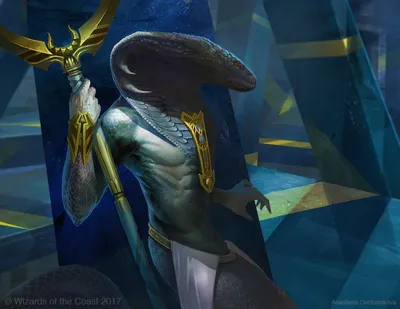
- Nagas
- Sphinxes
Domesticated races:
Wild races:
- Ammits
- Antelope
- Basilisks
- Bats
- Birds: ibises, vultures, gulls, owls, hoopoes
- Cats : cheetahs, lions
- Chimeras
- Cerodons
- Crabs
- Crocodiles
- Dragons
- Elephants
- Golems
- Hellions
- Hippos
- Horrors
- Horses
- Hydras
- Hyenas
- Insects
- Bees
- Locusts
- Scarabs
- Lizards
- Manglehorns
- Manticores
- River drakes
- River horses
- Sand Stranglers
- Sandwurms
- Scorpions
- Serpents
- Serpopards (Cat Snakes)
- Snakes
- Spiders
- Zombies

Flora
Planeswalkers
Native
Visitors
Non-planeswalker visitors
Gallery
-
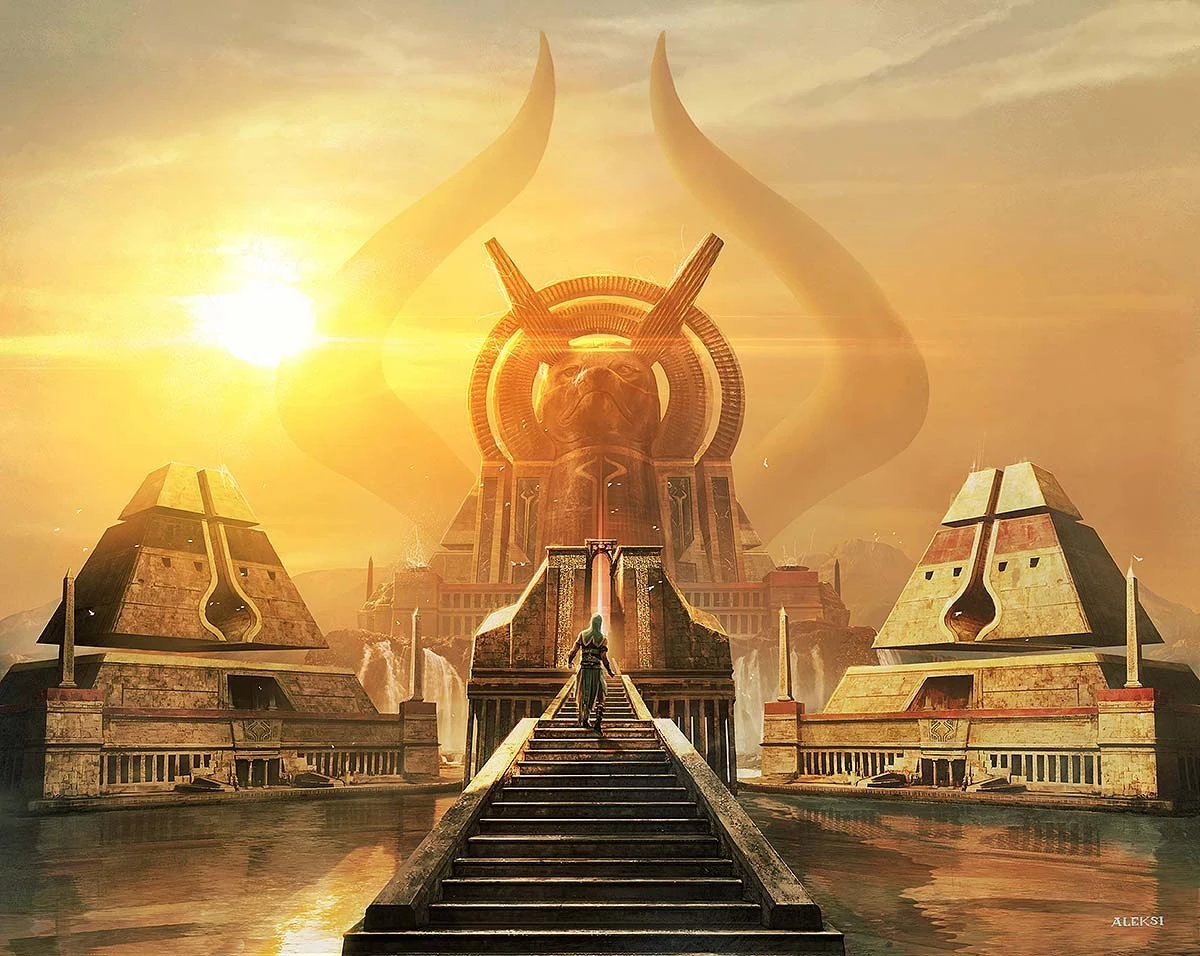
 Amonkhet packaging art by Aleksi Briclot.
In-game references
Artwork
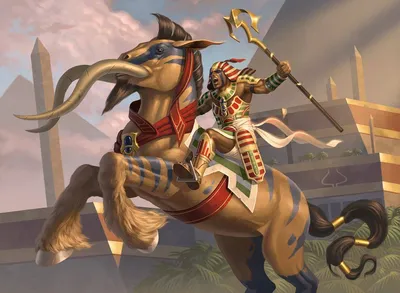
Ahn-Crop Champion
Craig J. Spearing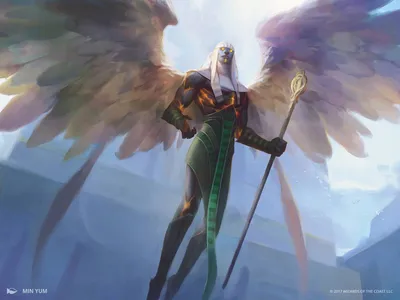
Angel of Sanctions
Min Yum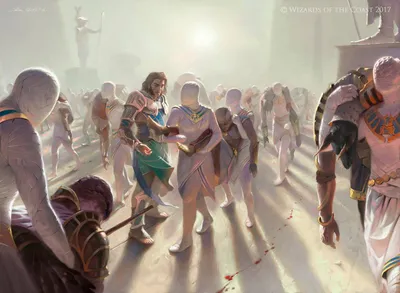
Anointed Procession
Victor Adame Minguez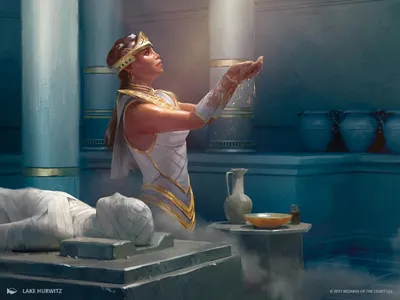
Anointer Priest
Lake Hurwitz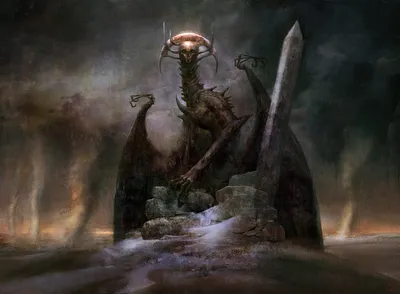
Archfiend of Ifnir
Seb McKinnon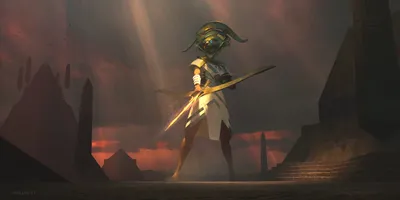
Austere Command (Invocations)
Richard Wright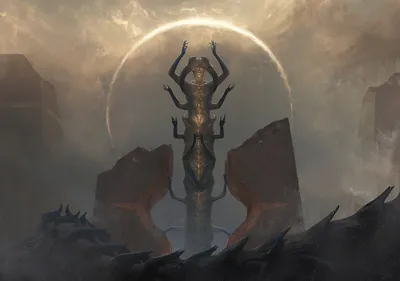
Avatar of Woe (Invocations)
Igor Kieryluk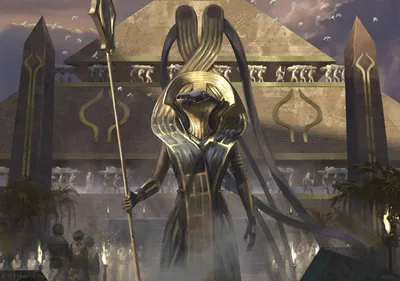
Bontu the Glorified (Invocations)
Daniel Ljunggren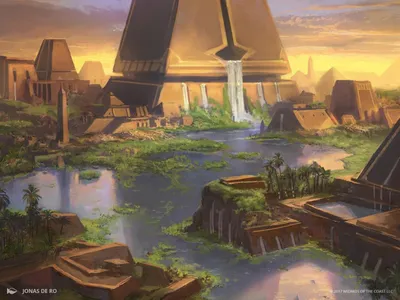
Bounty of the Luxa
Jonas De Ro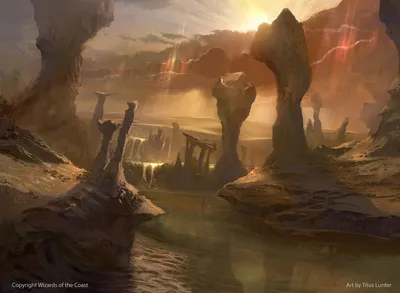
Canyon Slough
Titus Lunter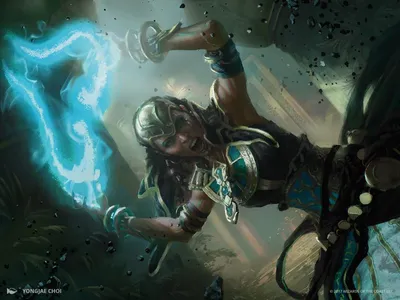
Channeler Initiate
Yongjae Choi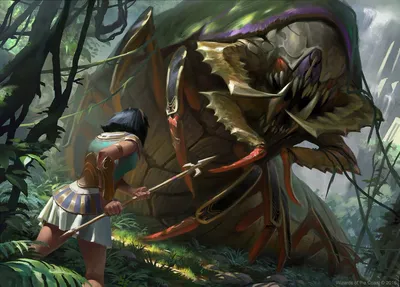
Colossapede
Jason Kang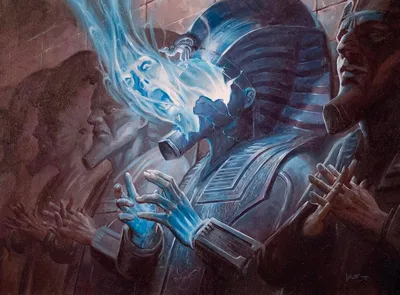
Compelling Argument
Lucas Graciano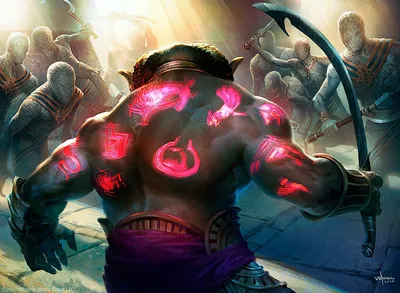
Consuming Fervor
Svetlin Velinov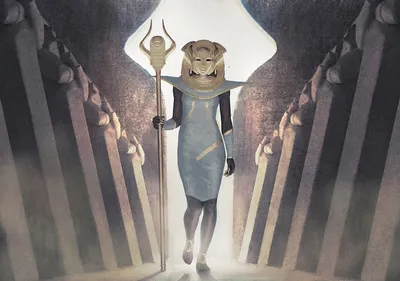
Containment Priest (Invocations)
Igor Kieryluk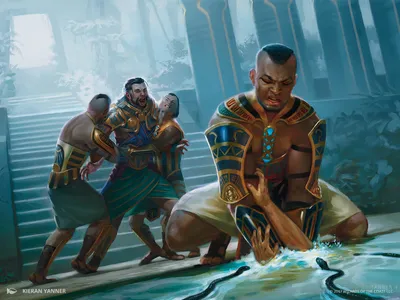
Cruel Reality
Kieran Yanner
Cryptic Serpent
Lius Lasahido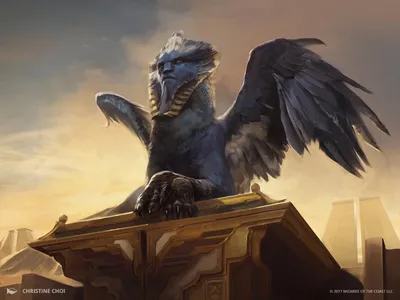
Curator of Mysteries
Christine Choi
Cursed Minotaur
David Palumbo
Cut
Raymond Swanland
Dark Ritual (Invocations)
Richard Wright
Dawn
Noah Bradley
Decision Paralysis
Vincent Proce
Deem Worthy
Lius Lasahido
Desiccated Naga
Svetlin Velinov
Dispossess
Mark Behm
Dissenter’s Deliverance
Bastien L. Deharme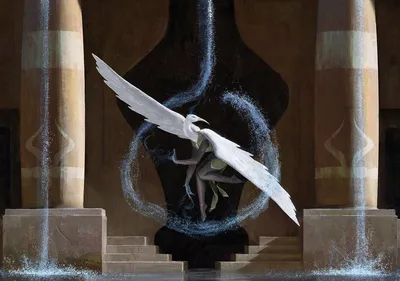
Divert (Invocations)
Igor Kieryluk
Dusk
Noah Bradley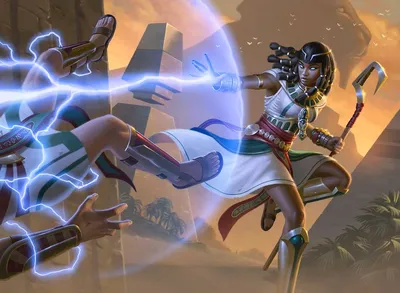
Electrify
Craig J. Spearing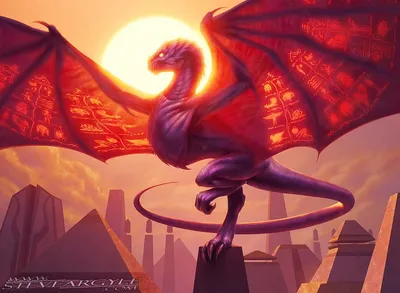
Enigma Drake
Steve Argyle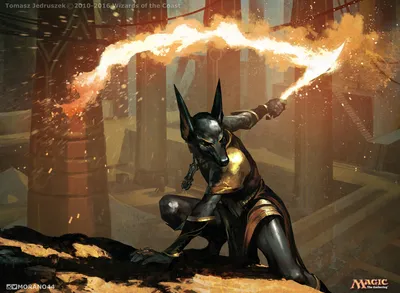
Flameblade Adept
Tomasz Jedruszek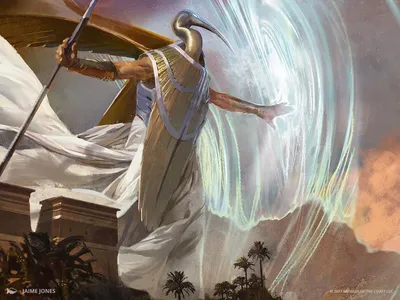
Force of Will (Invocations)
Jaime Jones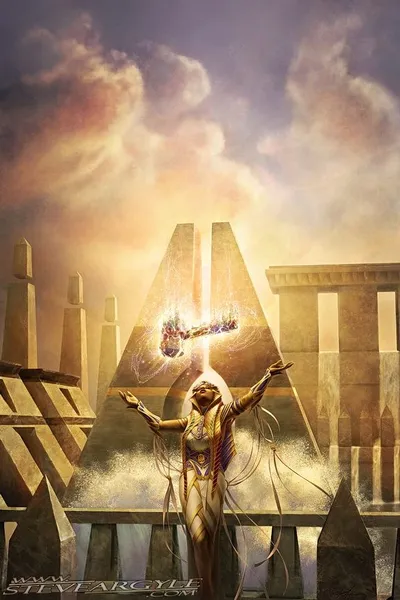
Forsake the Worldly
Steve Argyle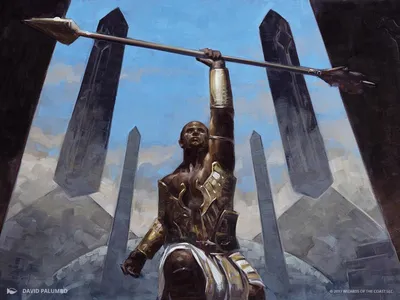
Glory-Bound Initiate
David Palumbo
Hapatra, Vizier of Poisons
Tyler Jacobson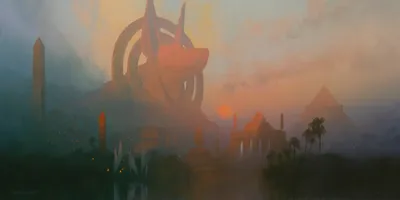
Hazoret's Monument
Richard Wright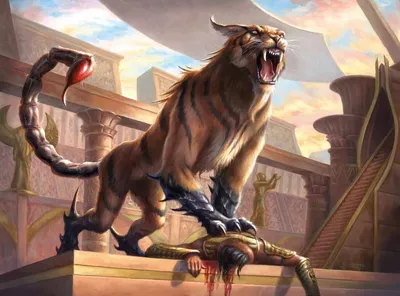
Heart-Piercer Manticore
Scott Murphy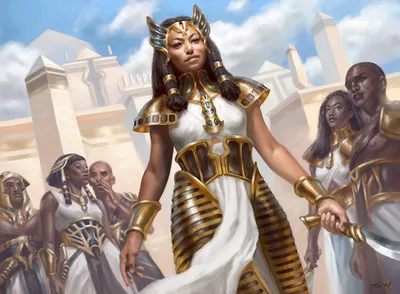
Honored Crop-Captain
Sara Winters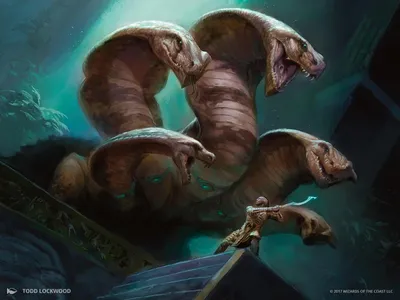
Honored Hydra
Todd Lockwood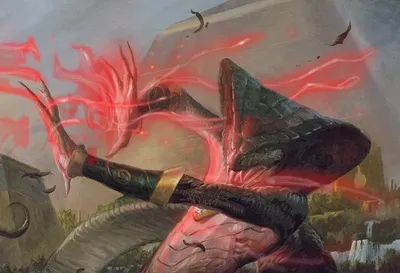
Injury
Lucas Graciano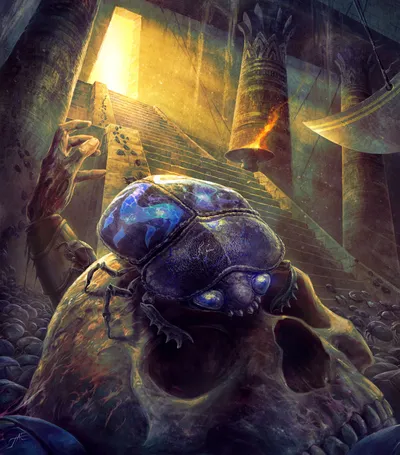
Insect Token
Jason A. Engle
Insult
Lucas Graciano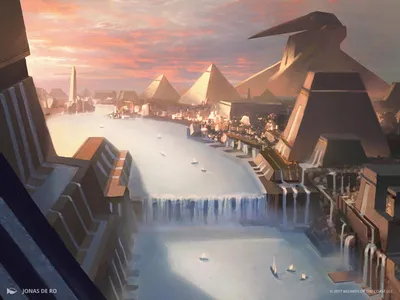
Island
Jonas De Ro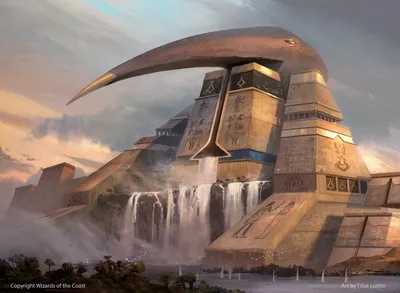
Kefnet’s Monument
Titus Lunter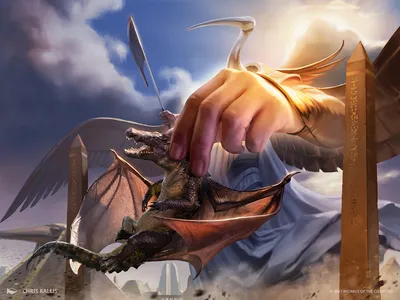
Lay Claim
Chris Rallis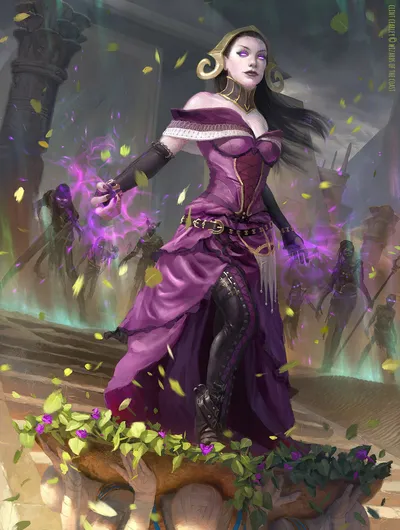
Liliana, Death Wielder
Clint Cearley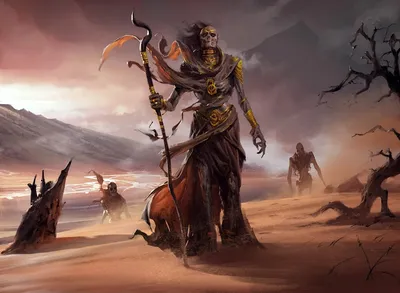
Lord of the Accursed
Grzegorz Rutkowski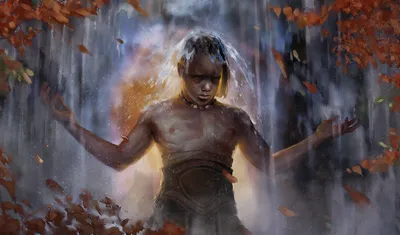
Mind
Josu Hernaiz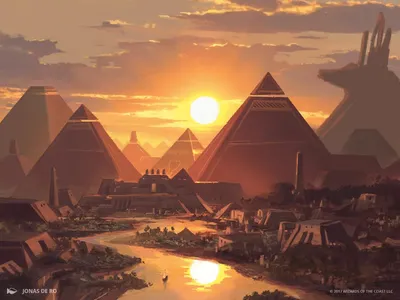
Mountain
Jonas De Ro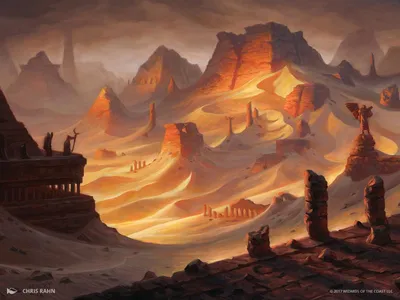
Mountain
Chris Rahn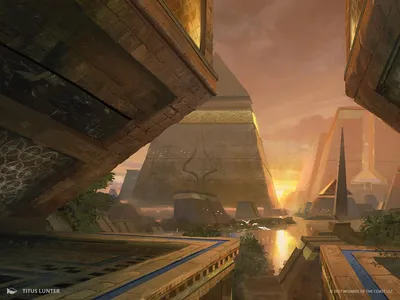
Mountain
Titus Lunter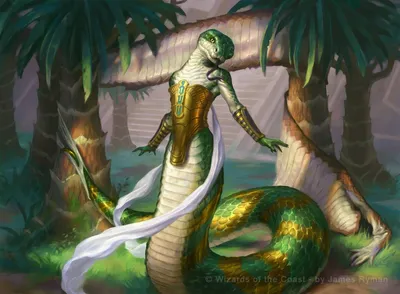
Naga Vitalist
James Ryman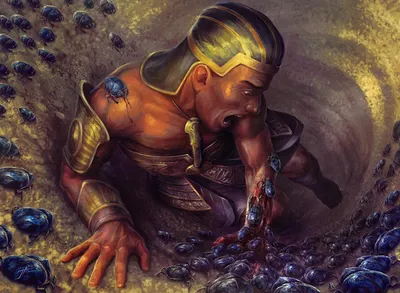
Nest of Scarabs
Jason A. Engle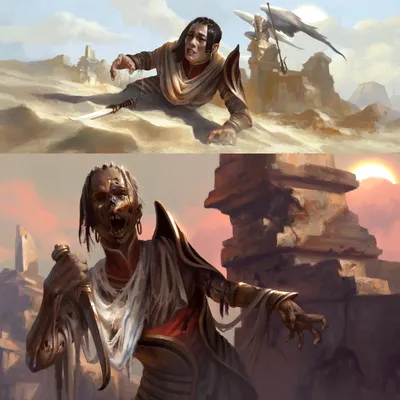
Never // Return
Daarken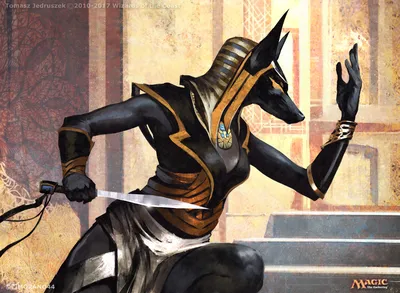
Nimble-Blade Khenra
Tomasz Jedruszek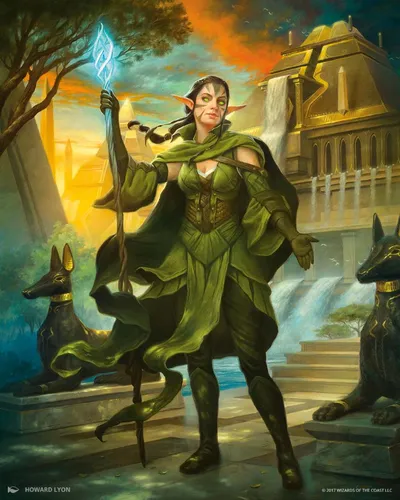
Nissa, Steward of Elements
Howard Lyon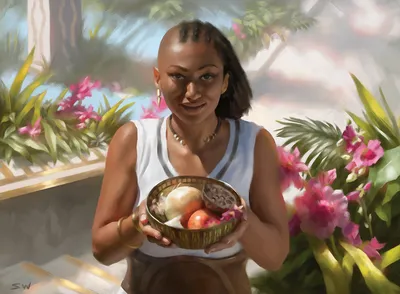
Oashra Cultivator
Sara Winters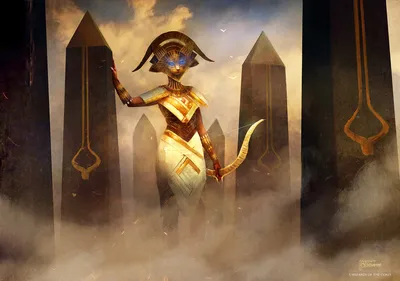
Oketra the True (Invocations)
Bastien L. Deharme
Pact of Negation (Invocations)
Titus Lunter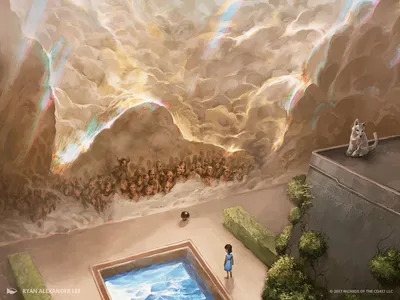
Protection of the Hekma
Ryan Alexander Lee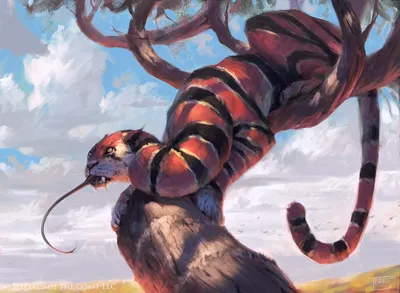
Prowling Serpopard
Tyler Jacobson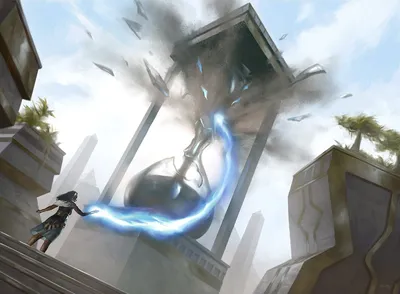
Pull from Tomorrow
Sara Winters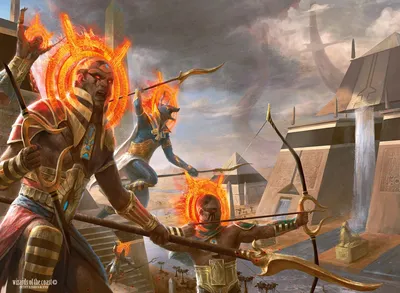
Pursue Glory
Johann Bodin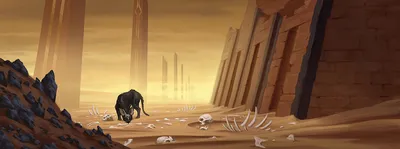
Rags
Greg Opalinski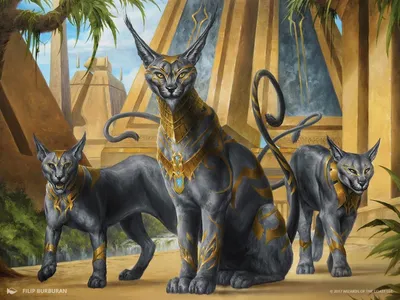
Regal Caracal
Filip Burburan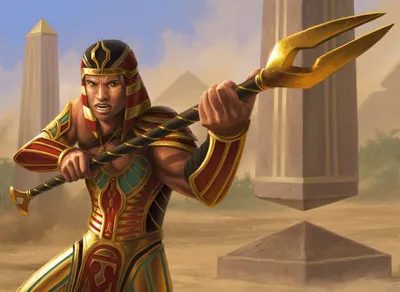
Rhet-Crop Spearmaster
Dan Scott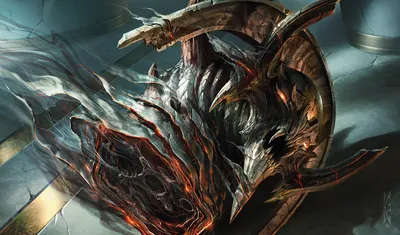
Ribbons
Raymond Swanland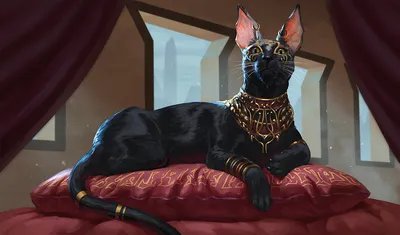
Riches
Greg Opalinski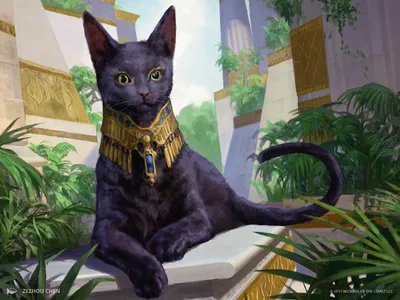
Sacred Cat
Zezhou Chen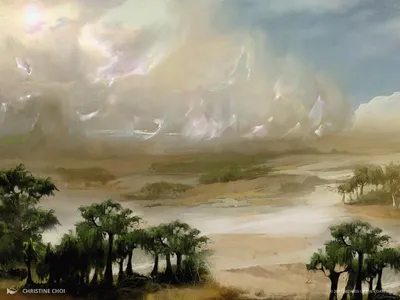
Scattered Groves
Christine Choi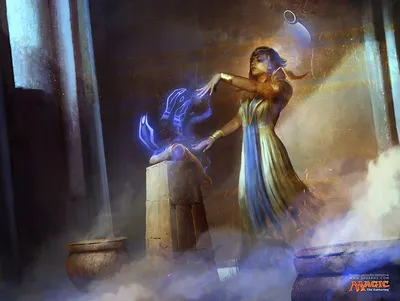
Scribe of the Mindful
Bastien L. Deharme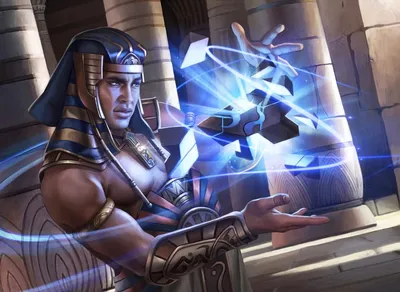
Seeker of Insight
Magali Villeneuve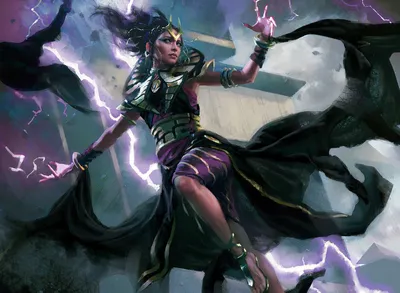
Shadowstorm Vizier
Yongjae Choi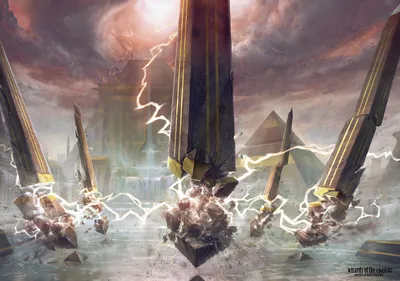
Shatterstorm (Invocations)
Johann Bodin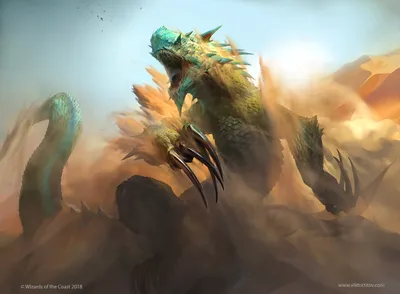
Shefet Monitor
Viktor Titov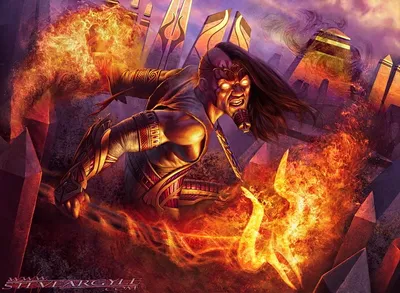
Soul-Scar Mage
Steve Argyle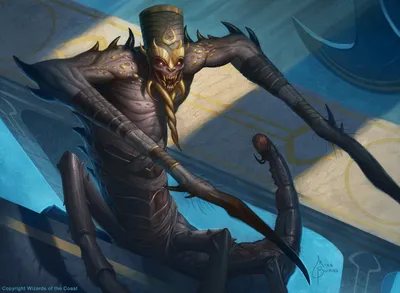
Soulstinger
Mike Burns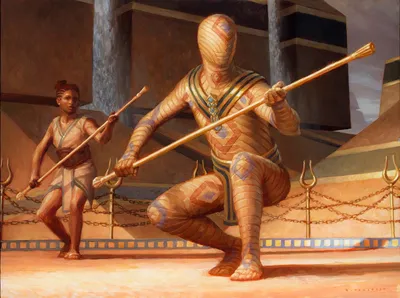
Sparring Mummy
Ryan Pancoast
Spell Pierce (Invocations)
Joseph Meehan
Spring
Josu Hernaiz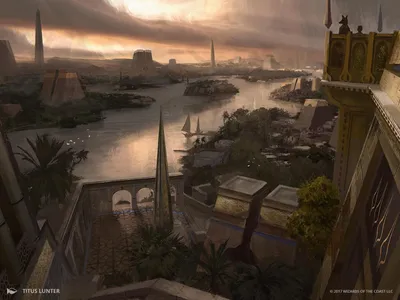
Swamp
Titus Lunter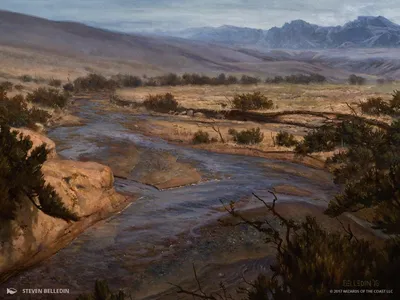
Swamp
Steven Belledin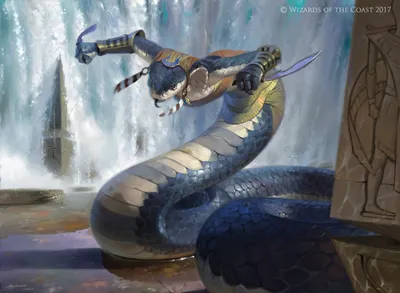
Tah-Crop Skirmisher
Victor Adame Minguez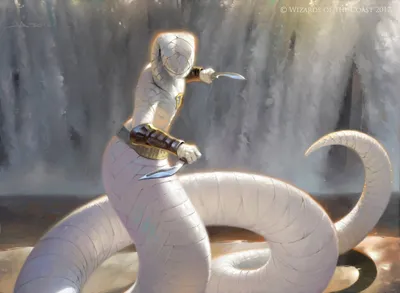
Tah-Crop Skirmisher Token
Victor Adame Minguez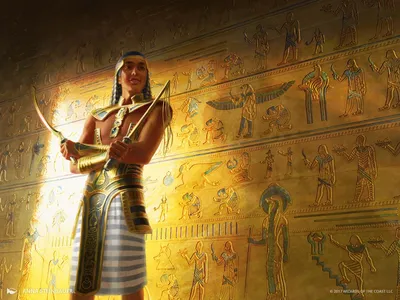
Temmet, Vizier of Naktamun
Anna Steinbauer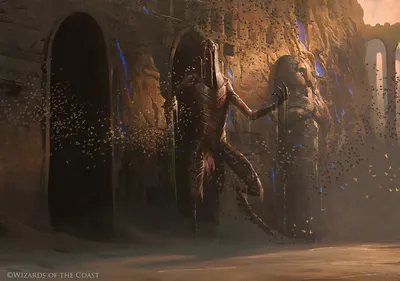
The Locust God (Masterpiece Series)
Grzegorz Rutkowski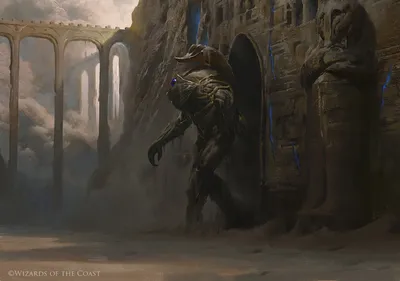
The Scorpion God (Masterpiece Series)
Grzegorz Rutkowski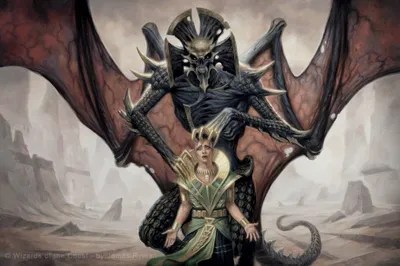
Thoughtseize (Invocations)
James Ryman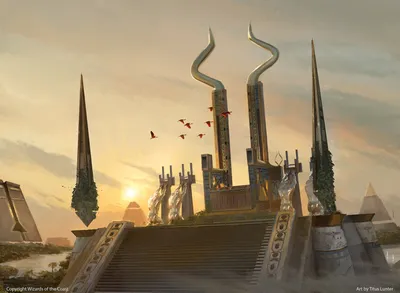
Throne of the God-Pharaoh
Titus Lunter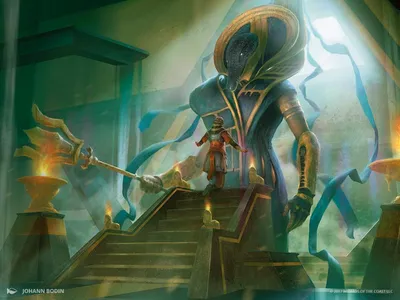
Trial of Ambition
Johann Bodin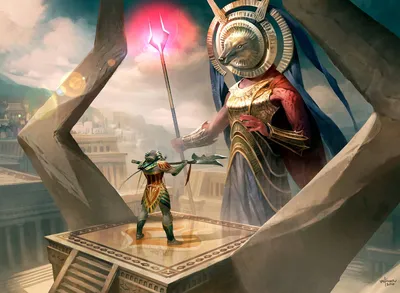
Trial of Zeal
Svetlin Velinov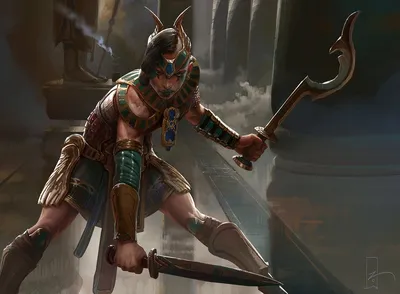
Trueheart Duelist
Izzy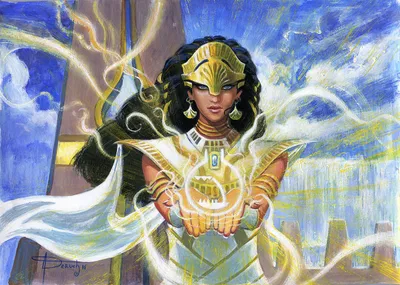
Vizier of Deferment
Deruchenko Alexander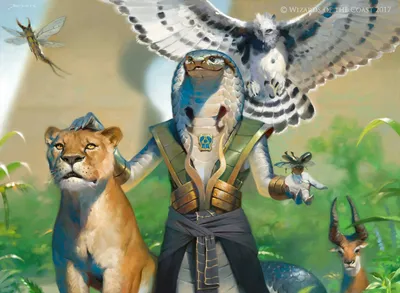
Vizier of the Menagerie
Victor Adame Minguez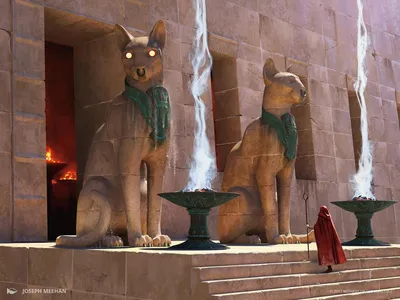
Watchers of the Dead
Joseph Meehan