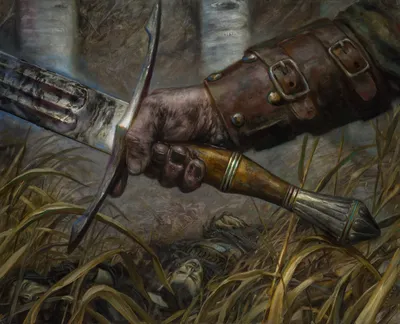
Orc
Orcs (or Orcses) were a race of humanoid creatures best known for their service as footsoldiers and slaves to the Dark Lords of Middle-earth. Even when not in thralldom to an evil master, Orcs rarely if ever had non-violent interactions with Elves, Men, or Dwarves.
Orcs (or Orcses ) were a race of humanoid creatures best known for their service as footsoldiers and slaves to the Dark Lords of Middle-earth. Even when not in thralldom to an evil master, Orcs rarely if ever had non-violent interactions with Elves, Men, or Dwarves. They were known by many names by the various peoples of Middle-earth.
Elves considered the Orcs as the Incarnate creatures just like themselves, Men, Dwarves, and Ents.
Characteristics
Culture
Orcs were pitiless and took pleasure in all kinds of cruel and wicked acts; they did evil deeds for their own amusement, purely for the sport of it. Their fractious and vicious natures made them unreliable servants – when outside their master's reach, Orcs would often disobey their commands or fight amongst themselves, to the detriment of their master's designs.
In battle, Orcs fought with reckless ferocity and delighted in the slaughter and torture of their foes. However, many had a cowardly nature and were often regarded as inferior to the soldiers of Men, Elves, and Dwarves, though far more expendable. Orcs also proved themselves adept at taming and riding Wolves and Wargs, an ability harnessed by the Dark Lords for their armies.
The corruption inherent to Orc being made them virtually powerless to resist the domination of a greater will – at first, this was Morgoth's, later Sauron's. While under such domination, Orcs were reduced to an "ant-like life." This was most plainly seen under Sauron's tyranny, as he operated on a smaller scale than did Morgoth and his foes were far weaker than the Noldor of the Elder Days. The Orkish people thus cycled between periods of unity when they had a Dark Lord to unite them, and disunity when there was no Dark Lord.
After the War of Wrath, the Orcs were confused and dismayed without Morgoth, and were easily scattered by their enemies. In the millennia after his defeat and banishment from Arda, they were without a leader and degenerated into small, quarrelsome tribes hiding in wild places, such as the Misty Mountains and the Mountains of Angmar. In this state, Orcs remained a threat to travelers and isolated settlements, and when united could pose a regional threat, but without a unifying will they could never become the menace they were under a Dark Lord.
Even when united, the Orcs were consumed with petty rivalries and hatreds. Each time he rose as Dark Lord, Sauron had to contend with many tribes of "wild" Orcs who spoke many tongues and had become accustomed to independence. To meld these disparate, mutually despised groups into a coherent force and prevent them from slaying each other, Sauron had to keep their hatred focused on an outside enemy: the Men and Elves of the West. In this he was highly successful: the Orcs he pressed into his direct service in his trained armies were so completely dominated by his will that they would die for him on command without hesitation.
Lifespan
Orcs appear to have been by nature short-lived compared with the span of Men of higher race, such as the Edain. This was not well understood in the Elder Days however, as Morgoth had many immortal Maiar servants and those whose business it was to direct the Orcs would assume similar bodily shape, though greater and more terrible. That gave rise to histories which speak of Great Orcs, or Orc-captains which were not slain and reappeared in battle for years far longer than the lifespan of Men.
There is, in any case, a hint for a long lifespan in the story of two of the most famous Orc-chieftains: Azog and Bolg. Bolg, being the son of Azog, was the chieftain of the Orcs who attacked Erebor in the Battle of Five Armies in T.A. 2941. Azog himself was killed in the Battle of Azanulbizar in T.A. 2799, so Bolg was at least 142 years old.
Appearance
Orcs were described as smaller in stature than Men on average, strong but crooked in frame and bow-legged. One "huge orc-chieftain" was described as "almost Man-high", but some must have been of a similar size to Hobbits (Frodo and Sam succeeded in disguising themselves as Orcs in Mordor). Their overall appearance varied: they had long arms and fanged mouths; Tolkien describes them as "swart" or "sallow", although one in Mordor is "black-skinned" and others are described generally as "black" (possibly not a reference to skin colour).
Orkish blood's colour was probably black.
Abilities & Behavior
Orcs of the mountains would often not venture very far from their homes unless they had to look for new homes, went to war or went on raids to get food or slaves. In such raids they would often obtain the help of Wargs with whom they then shared the plunder.
Orcs made no works of beauty, but created many clever things. When they took the trouble they were capable at tunneling and mining, surpassed only by the most skilled Dwarves, but they were usually dirty and untidy. Orcs were unafraid of fire but shunned water and did not willingly go near the sea except in great need.
Kinds of Orcs
- Eastern Orcs
- Snaga
- Orc-hunters
- Orcs of Mordor
- Orcs of the Misty Mountains
- Orcs of Isengard
- Half-orcs (and Goblin-men)
- Uruk-hai
- Hobgoblins
Orcs and goblins
The term goblin was used primarily in The Hobbit but also in The Lord of the Rings where it is used synonymously with "Orc". It is said to be a translation of Orc in a note on languages and runic letters in The Hobbit.
Orc is not an English word. It occurs in one or two places but is usually translated goblin
There were four goblin-soldiers of greater stature [...] Upon their shields they bore [...] a small white hand in the centre of the black field
Controversy
Tolkien's Orcs have been a subject of criticism of racism. Tolkien described Orcs as "squat, broad, flat-nosed, sallow-skinned, with wide mouths and slant eyes: in fact degraded and repulsive versions of the (to Europeans) least lovely Mongol-types".
Other writings
In The Father Christmas Letters, goblins appear as the enemies of Father Christmas and the Red Elves.
Artwork