Hobbit
Hobbits were a small race that typically dwelt underground, believed to be related to Men. They played little role in history, save during the War of the Ring.
Hobbits were a small race that typically dwelt underground, believed to be related to Men. They played little role in history, save during the War of the Ring.
Origin
Hobbits did not have legends concerning their origin. Lacking better evidence, it is suggested that they are a miniature variant of Men, or of a related branch. Nearly all scholars agree that Men were closely related to Hobbits, far more closely than Men were to either Elves or Dwarves. It was thus commonly assumed that Hobbits were among the Younger Children of Ilúvatar and were the result of the same act of creation as Men. This would imply that Hobbits had the Gift of Men to pass entirely beyond Arda.
It is supposed that Hobbits branched out from Men as a race in the Elder Days, but they don't appear at all in the chronicles of the Elves. Their exact origin is unknown but in their early days they could have been primitive and "savage". Apparently they survived in Middle-earth for millennia far from importance and the knowledge of stronger races; they come into the records not earlier than the early Third Age where they were living in the Vales of Anduin in Wilderland, between Mirkwood and the Misty Mountains. They have lost the genealogical details of how they are related to the rest of mankind. While they stayed there, the Northmen knew them. Their descendants, the Rohirrim, had that memory of the holbytlan and they remained an object of lore until they contacted them during the War of the Ring. Many old words and names in "Hobbitish" are cognates of words in Rohanese, so much so that even someone without linguistic training could make out the relation (Meriadoc Brandybuck would later write an entire book devoted to the relationship, Old Words and Names in the Shire).
Some well-known Hobbits
- Bilbo Baggins
- Frodo Baggins
- Samwise "Sam" Gamgee
- Meriadoc "Merry" Brandybuck
- Belladonna Took
- Peregrin "Pippin" Took
- Fredegar "Fatty" Bolger
- Otho and Lotho Sackville-Baggins
- Lobelia Sackville-Baggins
- Old Took
- Bullroarer Took
- Sméagol (who became the creature Gollum)
- Déagol
Though in The Hobbit it is mentioned that Gandalf "was responsible for so many quiet lads and lasses going off into the Blue for mad adventures," no female Hobbits are depicted in Tolkien's stories doing so; however Hobbit women do appear in his works, such as the formidable Lobelia Sackville-Baggins, Sam's wife Rose Cotton, and Belladonna Took, one of the Old Took's remarkable daughters, who is said to have given up adventuring upon marrying the respectable Bungo Baggins.
In popular usage
"Hobbit" is a trademark owned by the Middle-earth Enterprises, as some of names, places and artifacts included in The Hobbit and The Lord of the Rings by J.R.R. Tolkien. For this reason Dungeons and Dragons and other fantasy tend to refer to Hobbits and Hobbit-like races rather as Halflings (hin in the Mystara universe, hurthlings in Ancient Domains of Mystery).
Homo floresiensis, a possible species in the genus Homo (thus, related to humans) discovered in 2004, has been informally dubbed a "hobbit" by its discoverers due to its small size.
Fans have noted that in depictions and adaptations such as The Lord of the Rings (film series), Hobbits are shown with unusually large feet, a conception probably influenced by the widespread art of the Brothers Hildebrandt. However, Tolkien himself never mentioned that large feet was a general feature of Hobbits.
Artwork
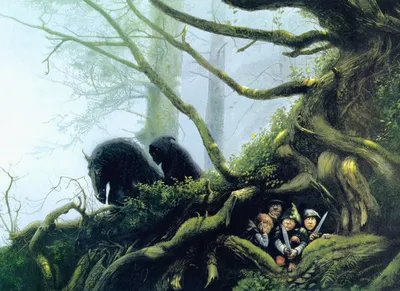
Hobbits Hiding from a Nazgul
John Howe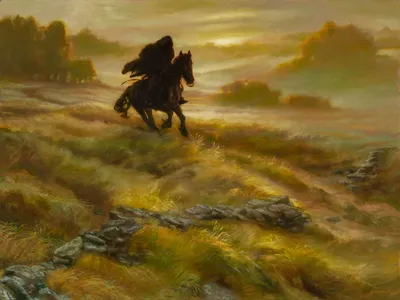
Searching for Baggins
Donato Giancola