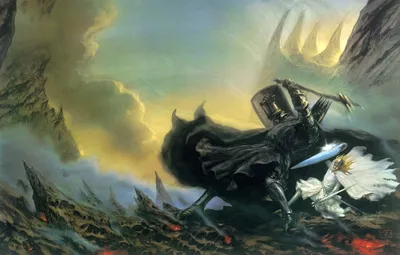
Fingolfin
Fingolfin was the first High King of the Ñoldor in Beleriand. He was the eldest son of Finwë and Indis, younger brother of Findis, older brother of Irimë and Finarfin, and the younger half-brother of Fëanor.
Fingolfin was the first High King of the Ñoldor in Beleriand. He was the eldest son of Finwë and Indis, younger brother of Findis, older brother of Irimë and Finarfin, and the younger half-brother of Fëanor. He founded the House of Fingolfin, which ruled the Ñoldor in Middle-earth. His wife was Anairë and his children were Fingon, Turgon, Aredhel, and Argon. Fingolfin was said to be the strongest, wisest, and most valiant of Finwë's sons.
He had a steed named Rochallor.
Biography
Life in Valinor
Fingolfin was born in Tirion in Valinor during the Noontide of Valinor. Neither he nor his brothers were particularly close to Fëanor; their elder half-brother had been opposed to his father remarrying, and thus he was rather scornful of them. Nonetheless, he lived in peace with his kin for many centuries. However, the peace of Valinor was brought to an end when Melkor, the most powerful of the Valar and the source of evil in Arda, was released from imprisonment. Feigning repentance and rehabilitation, Melkor's malice had in fact only festered and grown worse while imprisoned, and he sought to bring ruin upon the Elves for, as he saw it, causing his downfall. Of the three clans of Elves in Aman, only the Ñoldor welcomed him, as his knowledge was the greatest of any of the Valar. Gaining their confidence, Melkor was slowly able to spread lies and half-truths amongst them regarding the intentions of the Valar. Over time, these lies bore fruit and the Ñoldor began to openly debate remaining in Aman, and chief among the disgruntled Elves was Fëanor. One of the lies was that the sons of Indis, of which Fingolfin was the eldest, were trying to usurp Fëanor as the rightful heir of Finwë and seize the Silmarils, three magnificently beautiful gems that Fëanor had created, for themselves.
Fëanor, already not fond of his half-siblings, had little trouble believing the rumor. Fëanor hastened to Tirion and confronted Fingolfin, drawing his sword and threatening him with violence. When it became known what Fëanor had done to Fingolfin, he was called by the Valar to explain himself, and Melkor's lies were found out. However, Fëanor was held accountable for threatening Fingolfin and was banished to the fortress of Formenos in the north. Around twelve years later, the two brothers reconciled at a festival in Valinor (though Fëanor did so only grudgingly). However, during this festival, Melkor and the monstrous spider Ungoliant attacked, killing the Two Trees of Valinor and darkening all of Aman. They then assaulted the fortress of Formenos, where Melkor slew Finwë and stole Fëanor's Silmarils. In his pride, grief, anger, and selfishness, Fëanor sought revenge upon Melkor (now named Morgoth), and attempted to convince the rest of the Ñoldor to assist him by convincing them that journeying to Middle-earth would bring them glories and treasures untold. However, many were either not convinced or only half convinced, and deferred to Fingolfin, who was more trusted than his brother. Fingolfin, though not particularly keen to leave Valinor, had sworn to Fëanor to uphold his place as the elder brother, and did not want to abandon his people to the decisions of his rash and selfish brother. He decided to accompany Fëanor.
Life in Middle-earth
As such, Fingolfin ended up becoming the leader of the second and largest of the three Ñoldor hosts to leave Tirion for Middle-earth. Fëanor led the first, and Fingolfin's brother Finarfin led the third, smallest, and most reluctant host. Most of those who journeyed with Fingolfin were, though willing to leave Tirion, in no great hurry to do so, and so it took a longer time for them to start their journey than Fëanor's host. Unfortunately, this delay caused Fingolfin to make a grievous mistake, for not long after setting out, Fëanor attempted to seize the fleet of the seafaring Teleri Elves in order to get to Middle-earth. The Teleri resisted fiercely, and the vanguard of Fingolfin's host, led by Fingon, caught up with Fëanor's during the middle of a heated battle. Seeing this, Fingon mistakenly assumed that the Teleri had attempted to waylay the Ñoldor, perhaps even at the request of the Valar. He and the vanguard joined the battle against the Teleri, and soon thereafter, the rest of Fingolfin's host joined as well. The Teleri were overcome, and the resulting slaughter became known as the Kinslaying at Alqualondë. After the battle and the theft of the ships, the Ñoldor encountered a figure, possibly Mandos himself, who proclaimed a terrible Doom upon them for the Kinslaying. Hearing this, and having not participated at all in the slaughter of the Teleri, Finarfin's host turned back and returned to Tirion.
The rest of the Ñoldor continued north, but as the journey grew more and more dangerous, many of the Ñoldor, upset about the Kinslaying and having been reluctant in the first place, began to openly curse Fëanor. In response, he and those most loyal to him departed one night on the Teleri ships. Upon reaching Middle-earth, Fëanor burned the ships. The fires were spotted by Fingolfin's host, and they knew that they were betrayed. Fingolfin's host's only route to Middle-earth was now to cross the phenomenally dangerous ices of the Helcaraxë or to return to Tirion in disgrace and suffer the punishment of the Valar for their role in the Kinslaying. But Fingolfin wished to continue to Middle-earth, in no small part to confront the brother for his monstrous betrayal. Fingolfin's host chose to cross the Helcaraxë, but lost many of its members along the way, greatly increasing the wrath and bitterness that Fingolfin and his host felt for Fëanor's host. The host of Fingolfin finally arrived in Middle-earth at the rising of the Sun (FA 1) and was assailed by an Orc army in Lammoth resulting in the death of Fingolfin's youngest child. Destroying the Orc host, Fingolfin and his army approached the doors of Angband, Morgoth's great fortress and smote upon them, but Morgoth and his servants, dismayed by the light of the new Sun, stayed hidden inside. Fingolfin and the Ñoldor then came to the northern shores of Lake Mithrim (FA 2), from which the Fëanorian part of the host had withdrawn.
With virtually all of Fingolfin's host furious over Fëanor's betrayal, a civil war would almost certainly have broken out amongst the Ñoldor had it not been for the actions of Fingolfin's son Fingon. For after the initial confrontation of Fëanor's host against Morgoth's forces, the Elves had defeated their foes with relative ease, but Fëanor in his pride and wrath had thought to come upon Morgoth himself, and had pursued the remnants of Morgoth's army with only a small vanguard. Upon reaching Angband, this vanguard encountered a few Balrogs and had quickly been slain, with Fëanor falling at the hands of Gothmog, Lord of the Balrogs. After this, Morgoth had sent a false claim of parley to the new leader of Fëanor's host; his eldest son Maedhros. Expecting treachery, both sides sent greater force than agreed upon to the negotiation site, but Morgoth's had been accompanied by Balrogs, who slew the Elven company in short order and captured Maedhros. After failing to gain concessions from the Elves by offering to release Maedhros, Morgoth chained Maedhros to a cliff by one hand and left him there. Fingon quickly learned of this and, having been a great friend of Maedhros before Fëanor's divisive actions, he sought to rescue his friend and cousin. He succeeded, and both returned to the gathered Ñoldor, who were amazed at Fingon's actions. Seeking to keep his people united, Maedhros waived all claim to kingship, and Fingolfin thus became the first High King of the Ñoldor (YS 7). They were quickly able to establish mighty kingdoms in Beleriand, and subsequent attacks by Morgoth against them were repelled completely and with relative ease. Fingolfin established the Siege of Angband after the complete victory of Dagor Aglareb, and ruled in peace and prosperity from Hithlum, by the northern shores of Lake Mithrim. On FA 20, he hosted the famous feast of Mereth Aderthad in Eithel Ivrin, which was attended by emissaries from all the Elves in Beleriand. There Fingolfin retained close counsel and friendship with Maedhros.
Combat with Morgoth and death
After Dagor Aglareb, occasional raids and sorties would be launched from Angband, but the Elven forces keeping watch upon the fortress were able to repel these with relative ease. As the centuries past, these attacks became fewer in number as Morgoth came to realize that the Orcs unaided were simply no match for the Elves in anything less than overwhelming numbers. Thus the Elven kingdoms experienced a golden age lasting for around four hundred and fifty years, and green grass grew even to the gates of Angband. With the power of his people waxing, Fingolfin began to toy with the idea of directly assaulting Angband, and perhaps ridding the Elves entirely of the looming threat that was Morgoth. However, the idea was never acted upon in any meaningful sense. Most of the Elven lords were effectively content with the situation as it stood, and were reluctant to begin an endevor which, even in victory, would be costly in the extreme. Ultimately it made no difference, as neither Fingolfin nor his allies yet fully comprehended the power of Morgoth, and did not understand that overthrowing him or assaulting Angband in earnest were simply beyond their capabilities.
Morgoth himself was not idle during the four hundred years of the siege, and he spent the time increasing the strength of his forces and creating new, deadlier creatures than Orcs for his armies. After reaching what he believed to be sufficient levels of soldiers, Morgoth's armies burst into Beleriand in the Dagor Bragollach. Accompanied by massive volcanic eruptions, the Orcs, Balrogs, and the dragon Glaurung completely overran the Elven defenses surrounding Angband, driving far into the south of Beleriand and slaughtering untold numbers of Elves. Fingolfin's kingdom in Hithlum managed barely to defend itself, as the mountains surrounding it provided protection against the flame and magma Morgoth had caused to spew from the Iron Mountains. However most of the other kingdoms of the Ñoldor were destroyed, and many of their allies, both Elven and Edain, were slain.
The apparent totality of the defeat caused a great rage and despair to overcome Fingolfin, and he resolved to go to Angband and challenge Morgoth himself to single combat. He mounted his horse and proceeded to ride across Anfauglith with such wrath that it was said that those who saw him mistook him for the Vala Oromë. He rode to Angband, unhindered by any of Morgoth's servants, smote upon the gates and shouted a challenge for Morgoth to face him in single combat. Morgoth, though still said to be the "mightiest of all things in this world", was reluctant to face Fingolfin because despite his might, he alone of the Valar knew fear. But Fingolfin's challenge was made in such an insulting manner that Morgoth could not ignore it without losing face before his captains. As such, he donned black armor, took up a great hammer, and emerged from Angband. Fingolfin drew his sword, Ringil, and the duel began. Many times Morgoth attempted to smite Fingolfin, but the Elven King managed to dodge all of Morgoth's blows, and wounded the Dark Lord seven times. But at last Fingolfin grew weary, and Morgoth bore down upon the Elven king with his gigantic shield, thrice driving Fingolfin to his knees. Fingolfin rose up and continued to fight each time, but as Mandos had foretold, no power of the Elves could defeat Morgoth, a Vala. Eventually, Fingolfin stumbled backwards into one of the many pits carved by Morgoth's failed strikes, and Morgoth stepped on the Elven King's neck and killed him. However, Fingolfin's last, desperate stroke managed to cut into Morgoth's heel.
After defeating him, Morgoth took Fingolfin's body and broke it, intending to feed it to his wolves. But Thorondor, the King of Eagles, swooped down upon Morgoth and with his talons slashed at Morgoth's face. As Morgoth reeled from this new assault, Thorondor retrieved Fingolfin's body and brought it to a mountaintop overlooking Gondolin. Turgon built a cairn named Sarnas Fingolfin over the remains of his father, and Fingon, in sorrow, became High King of the Ñoldor. After Fingolfin's defeat, though he had been defeated by Morgoth, the Orcs never made any type of boastful song to celebrate, nor did the Elves sing of it, for their sorrow was far too great. Morgoth walked with a limp after the duel, and the wounds he received pained him forever.
Etymology
Fingolfin's father-name was Ñolofinwë, meaning "Wise Finwë" from the Quenya ngolod ("wise"). His mother-name was Arakáno, "High Chieftain", from ara ("high") and káno ("chieftain"). The name Fingolfin is the Sindarin form of his name.
House of Fingolfin
In other versions
In The History of Middle-earth, Fingolfin had another son, Argon, who fought and died in the Battle of the Lammoth. However, Christopher Tolkien excluded him from The Silmarillion.
In earlier versions of the legendarium, the character was named Golfin, and his father was Gelmir, King of the Gnomes. Along with his father and brothers Delin and Lúthien, Golfin led the host of the Gnomes to the Great Lands, and his banner had "upon gold a silver sword".
Gallery
Translations
References
Settings
Artwork
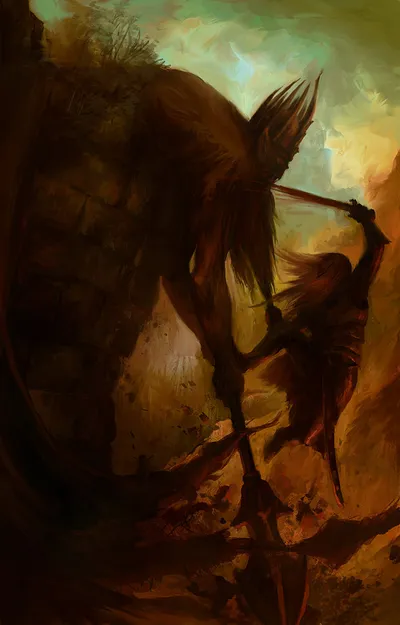
Fingolfin and Melkor
Pete Amachree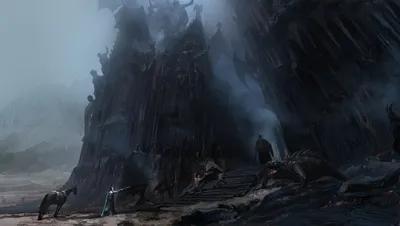
Fingolfin challenges Morgoth
Pete Amachree