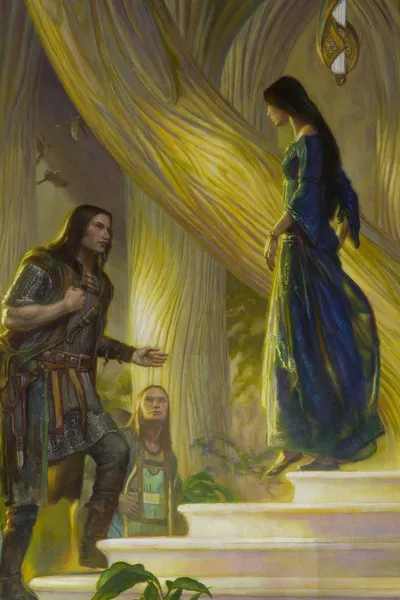
Thingol
He was the founder and first King of the central Kingdom of Doriath and was respected by all the Sindar of Beleriand, who considered him as the Lord of Beleriand and thus supreme ruler of all the Elves who dwelt in the lands between the Blue Mountains and Great Sea.
He was the founder and first King of the central Kingdom of Doriath and was respected by all the Sindar of Beleriand, who considered him as the Lord of Beleriand and thus supreme ruler of all the Elves who dwelt in the lands between the Blue Mountains and Great Sea.
Biography
Sundering of the Elves
Elwë was born in Cuiviénen during the Years of the Trees to unnamed parents, and his father was the direct descendant of Enel and Enelyë. He first appears in the history of the Eldar when he travelled from Cuiviénen with Oromë as ambassador of the Teleri to see the land of Valinor. Upon his return, he convinced many of his people to follow him back to that country. On the Elves' Great Journey to the West, the Teleri lingered behind and did not arrive at the coast until later, after the departure of the moving island of Tol Eressëa. Thus, they stayed in Beleriand for many years until Tol Eressëa was brought back to ferry them, by which time many of the Teleri had grown to love Beleriand and decided to stay there. Elwë was among them, having encountered Melian the Maia in the woods of Nan Elmoth and fallen deeply in love with her. Afterwards, he disappeared for many years causing many of his people to linger in Middle-earth to search for him.
Rule of Doriath
For centuries, Elwë remained lost until he reemerged as a respected lord and many of his people joined him in the forest of Doriath, in Beleriand. Now known as Elu Thingol, he and Melian became king and queen of the Teleri that remained in Beleriand. This people became known as the Sindar. He founded a realm in a large forested area in Beleriand first known as Eglador (Land of the Forsaken). During these early days under the stars, Thingol and Melian had a daughter, Lúthien, who was said to be the fairest woman ever to have lived.
As Lord of Beleriand, Thingol welcomed his long lost kin, now known as the Laiquendi or Green-elves, into vast lands in Ossiriand. He was also the first Elf to make contact and alliances with the Dwarves of Belegost, who helped delve the caves of Menegroth, which became the capital of Thingol's kingdom. When the Dwarves first became aware of unfamiliar savage creatures coming out of the North, Thingol was the first to learn, and, possessing no heavy weapons of war, he once again asked the Dwarves for their aid. They forged for him necessary weapons and armour, for what would be the onset of war against Melkor.
Quest for the Silmaril
When Melkor returned to Middle-earth, he sought once again to master it and its peoples, and declared war on them. He sent great hosts of Orcs into Beleriand, starting what became known as the First Battle of Beleriand. In this battle, Thingol led his people to victory against the Orcs, driving them out of his kingdom and most of Beleriand. Afterwards, Melian set the Girdle around his kingdom, which was thence named Doriath; no one could now enter the realm without Thingol's permission. When the Ñoldor returned to Middle-earth, he gave them leave to dwell in the north part and dealt only with the House of Finarfin as they were kin through his brother Olwë. When he learned of the Kinslaying at Alqualondë, he was outraged and wanted nothing to do with most of the Ñoldor and their war and even outlawed the use of Quenya in his kingdom.
Thingol was drawn into the war with Morgoth and the deadly Oath of Fëanor when after the Dagor Bragollach, Lúthien fell in love with a man named Beren. Thingol did not wish for the two to be wedded to each other, as he valued his daughter very highly and disliked the race of Men. As a bride-price he asked for a Silmaril from the crown of Morgoth, thinking there was no way that Beren could fulfil this demand. Thus, Thingol was drawn into the quarrels over the great jewels and ultimately the doom of Fëanor.
Death
It was this bride-price that doomed Thingol. After Húrin brought the treasures of Nargothrond to Doriath, Thingol summoned Dwarves of Belegost to Menegroth and invited them to work the treasure into jewelry. The finest of these pieces was the Nauglamír.
The Nauglamír was the second-greatest treasure of Doriath, prized above all but Beren and Lúthien's Silmaril. After the smiths of Belegost finished their work on the Nauglamír, Thingol requested that the Dwarves of Nogrod set the Silmaril in it. The Nauglamír, now bearing the Silmaril was held to be the fairest object in Arda.
Enthralled by and covetous of the Silmaril, the Dwarves demanded the necklace, insisting that as a dwarven work it belonged to them. Thingol was unwilling to surrender the treasure and replied with an impertinent answer. In their anger, the Dwarves attempted to slay him. After a long battle between Dwarves and Elves inside the city, the Dwarves were expelled. Two escaped to Nogrod and there told a false story of the conflict to their people, convincing them to march westward and do battle in the Thousand Caves. Later, with the help of certain treacherous Elves also possessed of the cursed treasure, Dwarves regained entrance past the Girdle. Thingol was lured out on a hunt with a small company of arms; he was ambushed by Dwarves in the woods, and was slain, allowing Menegroth to be taken and plundered. The Dwarves could not seize nor harm Melian, and she departed to seek Beren and Lúthien.
Thingol's heir was Dior Eluchil, the son of Beren and Lúthien.
Etymology
Elu Thingol is derived from the Sindarin Elu Sindacollo, meaning "Elu Greycloak", from thind or sinda ("grey") and collo ("cloak").
The original form of his name was Elwë Singollo, from the Quenya el ("star") and wë ("person").
In other versions
Thingol underwent quite a bit of developmental changes. In an earlier account, Tinfang was the son of Tinwelint. In some of the earlier writings, and in particular the drafts for The Hobbit, Thingol was said to be the leader of the Dark Elves, and was a Dark Elf himself. This note of him being referred to as the Dark Elf as one of his nicknames/titles/insults is still seen in the published Silmarillion: "...this Dark Elf in his caves!"
Weapons
Thingol's sword was called Aranrúth ("King's Ire") which later became the sword of the Númenórean kings. He also owned Anglachel, the sword forged by Eöl who gave it to him as payment for dwelling in Nan Elmoth. He later gave Anglachel to Beleg.
House of Thingol
Appearances
- The Silmarillion
- Unfinished Tales of Númenor and Middle-earth
- The Children of Húrin
- Beren and Lúthien
Translations
References
Settings
Artwork
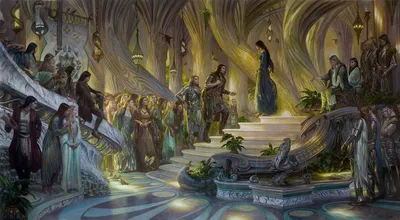
Beren and Luthien in the Court of Thingol and Melian
Donato Giancola