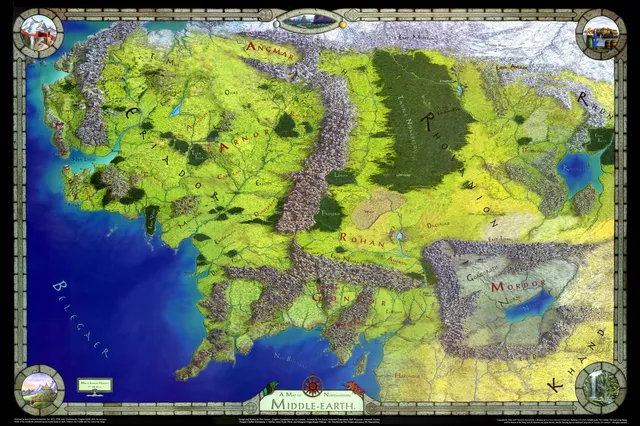
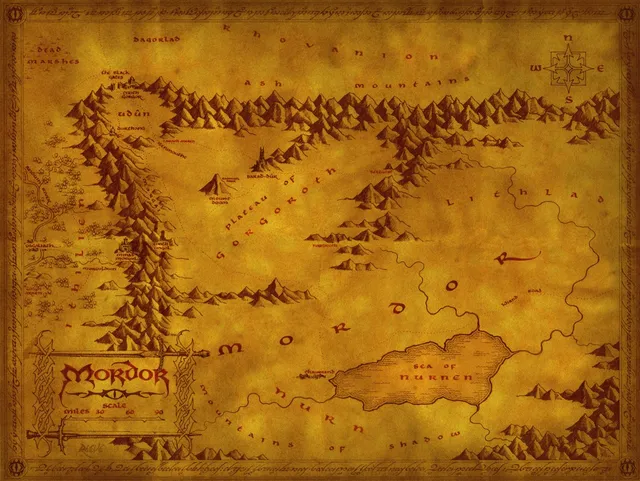
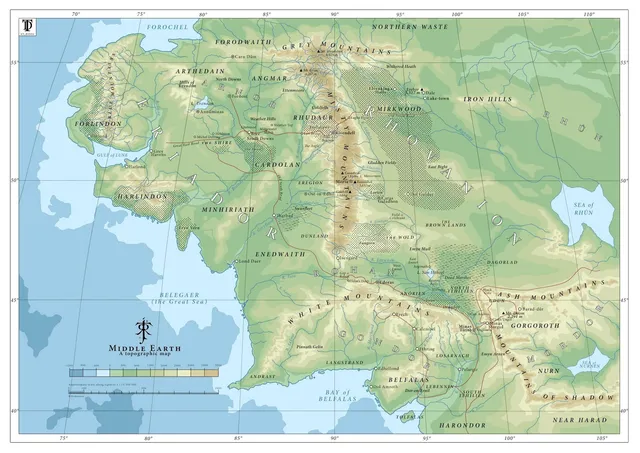
Gorgoroth was a high desolate plain in north-western Mordor enclosed by the Morgai and the Ephel Dúath in the west, the Ephel Dúath and the Ered Lithui in the north, by a mountain arm that branched off from the Ephel Dúath in the south and by a mountain arm that branched off from the Ered Lithui in the south-east.
The only known passages into the plateau through these mountain walls were the Isenmouthe (from the valley of Udûn in the south of the Morannon), the rift in the Morgai in the east of the Pass of Cirith Ungol and the east of the Morgul Pass and the gap between the mountain arm that branched off from the Ephel Dúath to the east and the mountain spur that branched off from the Ered Litui to the south-west.
In this dreary wasteland fumes issued from fissures in the ground and smoke curled and settled in hollows. Centred in the desolation some forty miles east of the Ephel Duath rose Mount Doom. It and Barad-dûr, situated on a mountain spur of the Ered Lithui, dominated the landscape of the plateau.
c. S.A. 1000 Sauron selected Mordor as his stronghold and began building Barad-dûr above the plateau of Gorgoroth.
In S.A. 3434 the host of the Last Alliance of Elves and Men entered Gorgoroth and began their siege of Sauron's fortress, during which Anárion was slain in S.A. 3440). After seven years the siege ended when Sauron was defeated and his Ring was taken.
Sauron returned to Mordor in T.A. 2951 and began rebuilding Barad-dûr, which had been torn down after his defeat in the Second Age.
When Frodo and Sam first looked upon Gorgoroth on 16 March T.A. 3019, they saw innumerable camps of Men made of huts and drab buildings, connected by a network of roads. In this region were Sauron's mines and forges for equipping his vast armies.
On 19 March T.A. 3019, after escaping the Orcs at the Isenmouthe, the hobbits travelled on the road to Barad-dûr along the northern edge of Gorgoroth. Three days later they left the road and headed south across the plateau to Mount Doom, reaching it on 24 March.
Artwork

Road to Mt Doom
Donato Giancola