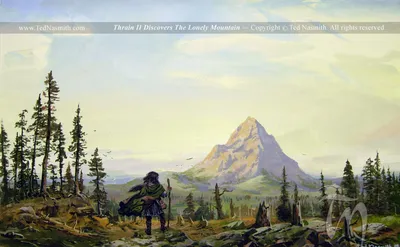
The Lonely Mountain (S. Erebor) was a large, solitary mountain in the north-east of Rhovanion and the source of the river Running. It housed the vast underground Dwarven city of the Kingdom under the Mountain and stood as one of the most importantDwarven realms of the Third Age.
Founded by Thráin I after the loss of Khazad‑dûm, Erebor became a centre of trade and craftsmanship, maintaining close ties with the neighbouring Men city of Dale. The kingdom reached its height under King Thrór, whose wealth drew the dragon Smaug to sack the mountain and drive the Dwarves into exile.
Erebor was reclaimed during the Quest of Erebor, when Thorin II Oakenshield and his companions reached the mountain and Smaug was slain. The Battle of Five Armies followed, after which Dáin Ironfoot restored the kingdom. In the War of the Ring, the Dwarves and Men of the region again defended Erebor, which endured as a renewed Dwarven realm into the Fourth Age.
Geography
The Lonely Mountain rose as a solitary, star‑shaped peak, with six ridges extending outward as spurs. It was possibly about 3,500 metres in height, and its summit remained snow‑capped even in Spring. The mountain was rich in metals and jewels.
The south-western spur held Ravenhill, which served as a Dwarven guardpost. Between the two western spurs and behind an overhanging cliff was a narrow vale which was the exit from the Back Door. Rough steps ascended to the top of the southern ridge along a narrow ledge that turned eastward behind a boulder into a steep bay.
Within the mountain, the Dwarves had dug passages and tunnels leading to cellars, halls and mansions, including the Great Chamber of Thrór near the Front Gate, and a secret tunnel that led to the bottom-most cellar.
The Front Gate was the main entrance into the mountain. It stood on the southern side and opened into a valley between two great spurs. The River Running sprang from beneath the mountain and issued from the Front Gate, forming a waterfall that fell into the valley below.
Inside the Front Gate a broad paved road followed the river into the mountain in a wide curve. Not far from the Front Gate lay the Great Chamber of Thrór, where feasts and councils were held. Deeper within the Lower Halls, at the root of the mountain, was a vast chamber called the Great Hall of Thráin. From this hall a secret passageway led to the Back Door, invisible from the outside except on Durin's Day, when the light of the setting sun revealed its keyhole.
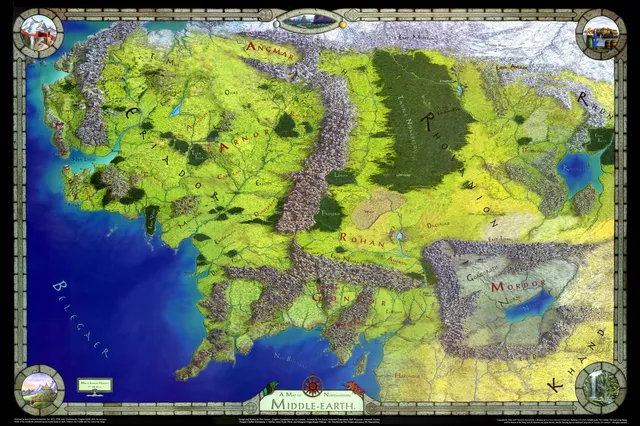
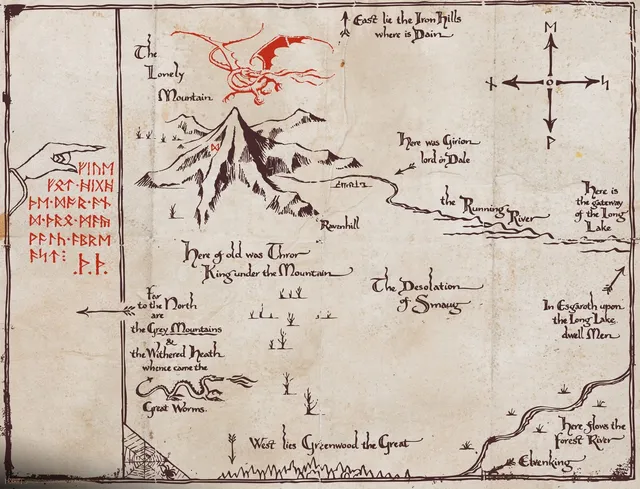

The Longbeards held Erebor from at least the early Second Age. After the awakening of Durin's Bane in Khazad-dûm, Thráin I led a company of Dwarves eastward and delved halls and passages, establishing the Kingdom under the Mountain in T.A. 1999. During Thráin's rule many riches were mined from the depths of the mountain, including the Arkenstone.
Thráin's son, Thorin, abandoned the Mountain in T.A. 2210 in favour of the Grey Mountains, which were largely unexplored and richer in ores. He also hoped to reunite the Longbeards. Although these mountains were likely larger than Erebor, the region later became troubled by dragons, and after the war of the Dwarves and Dragons in T.A. 2590, King Thrór returned to the Lonely Mountain and re-established it as the capital of Durin's folk, though some would follow his brother Grór into the Iron Hills.
Erebor again grew prosperous, which led to the establishment of the town of Dale, built by Men between Erebor's slopes. The Dwarves mined and expanded the tunnels and halls beyond those of their earlier settlement. The Dwarves of Erebor were treated with reverence by the Men of Dale. The friendship and commerce between these two settlements became renowned throughout the North.
In T.A. 2770, the dragon Smaug descended upon the mountain, driving out the Dwarves and destroying the town of Dale. The Lonely Mountain afterward lay empty for nearly two centuries, occupied only by Smaug, who slept in the innermost chamber on a great treasure hoard. No Dwarf or Man approached the mountain while the dragon remained.
In T.A. 2941, a small company led by Thorin Oakenshield returned to Erebor with the aim of reclaiming their kingdom. After the Smaug had realized that the Dwarves had been helped by the Lake-men, he went to their town of Esgaroth intent on destroying them, only to be killed by a man named Bard.
With the death of Smaug, the Lonely Mountain was left unguarded, and Thorin and company were able to reclaim the Erebor and its treasure. Thorin Oakenshield briefly took the title of King under the Mountain, but succumbed to Dragon Sickness, which caused dispute between Thorin, Men of Esgaroth and Elves of Mirkwood. A siege of Erebor and then the Battle of Five Armies followed, in which Thorin was wounded by goblins, and died within the mountain.
His cousin, Dáin Ironfoot, then became king and re-established the Kingdom under the Mountain, returning the Longbeards to their ancestral home and Erebor to its former glory. Under Dáin’s rule, the Longbeards began rebuilding their city within and on the mountain, including the roads dug deep underground and the towers built on the mountain, later described by Glóin to Frodo Baggins.
During the War of the Ring, Erebor and the neighbouring Kingdom of Dale were attacked by an army of Easterlings under Sauron's rule. The Dwarves and Men retreated into the mountain after King Brand and King Dáin were killed at its gates on 17 March T.A. 3019, and they withstood a siege until news of Sauron's defeat caused the attackers to despair and lose hope. At this, the besieged emerged from the mountain and attacked and drove the Easterlings from Dale across the river Running.
Erebor and Dale continued to prosper well into the Fourth Age, and the Lonely Mountain remained an important stronghold of Durin's Folk even after the Longbeards reclaimed Khazad-dûm.
Artwork