History
Forodwaith was first created after the War of Wrath, when most of the Iron Mountains were destroyed. Its geographical predecessor was the region of Dor-na-Daerachas, which was hemmed behind the Iron Mountains.
Little was known of Forodwaith, except that it was an area of immense cold due to the proximity to the Gap of Ilmen, and Morgoth's evil cold. After the War of Wrath and the breaking of the World, the Iron Mountains were mostly destroyed, and the area of Forodwaith that lay directly north of Eriador became known as Forochel, together with the great icebay and cape that carried the same name. Some of the Dragons fleeing the War of Wrath also journeyed into the Northern Waste, where they would multiply over many centuries.[citation needed]
The Men of Forodwaith were a strange folk, apparently unrelated to the Edain. During the Third Age, they were known as the Snowmen of Forochel or Lossoth. In Unfinished Tales, it is stated that they could glide on ice by tying bones to their feet.
Arvedui, last King of Arthedain, fled to the Icebay of Forochel after his realm was destroyed by Angmar, and the Lossoth helped him survive the winter. Against their advice, he took ship to sail south, and he was drowned in the icebay, together with the Palantíri of the North. The chieftain of the Lossoth counseled Arvedui not to go aboard the ships and face the bitter northern winter, but the king refused and went anyway. In payment for his safekeeping, King Arvedui gave to the Lossoth his ring, the Ring of Barahir, and bade them ransom it to his kin when the Lossoth had need. Unfortunately, the chieftain's counsel proved wise, and Arvedui was lost at sea, thus ended the Kings of Arnor, and their line continued as the Chieftains of the Dúnedain of Arnor.
Geography and climate
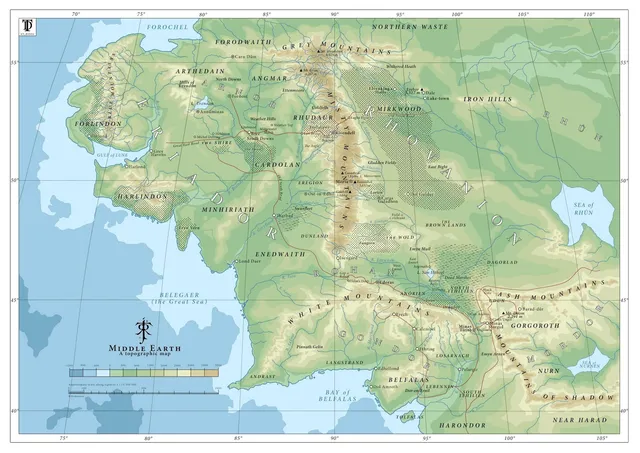
Forodwaith was located in the northernmost part of Middle-earth. It was a vast tundra, reaching all the way to the northern poles, and spanning across most of Middle-earth, until it hit the northern peaks of Orocarni to the East. It was dominated by a polar climate, which is characterized by each month having an average of less than fifty degrees Fahrenheit.
Etymology
The Sindarin name Forodwaith translates loosely as "Northern lands", and was a name for the land north of the Iron Mountains of the First Age.[citation needed]
In other versions
In earlier versions of the legendarium, the Forodwaith were originally conceived as a mythical representation of the Vikings, while their land, i·Ponōrir, was the mythical representation of Scandinavia. In this tales one of their chieftains, Orm, killed the father of Ælfwine/Eriol.
In adaptations
The Lord of the Rings: The Rings of Power
Forodwaith appears in the first episode of The Rings of Power as the location where Galadriel leads a small force to look for evidence of Sauron's whereabouts. They discover an abandoned fortress built by Morgoth in which remains an anvil marked by Sauron; Galadriel's followers are here attacked by a snow-troll, which she defeats. The location also appears in a flashback of the first episode of the second season, where Sauron attempts to coronate himself among the orcs of that time.