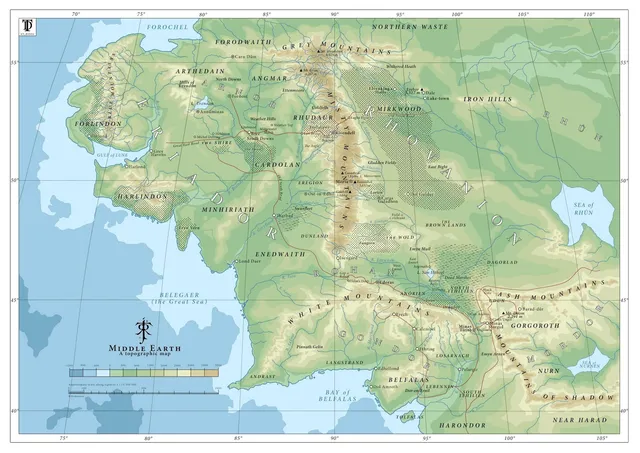
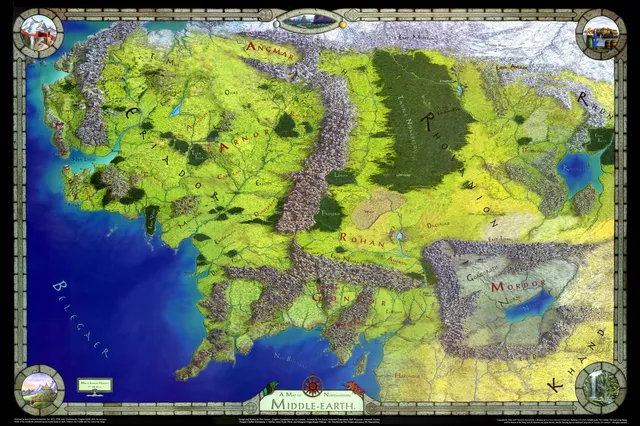
The Iron Hills were a range of great hills in the north-east of Wilderland. The Hills were the source of the river Carnen and rich in iron. It was also home to a Dwarf-realm of the Longbeards.
Although the Iron Hills were rich in iron, they were probably not in gold; the Dwarves of the Iron Hills, although prosperous, were not as wealthy as their other cousins (e.g. the Kingdom Under the Mountain).
Early history
The Longbeard Dwarves of Khazad-dûm colonized the Iron Hills in the First Age. The Hills were their primary source of iron-ore, and so the Dwarf-road of Mirkwood ran north-east to the Hills for the dwarf-traders and merchants between Khazad-dûm and the Hills.
Also in the First Age, some Men who migrated out of the east—"laggard kindred" of the Edain—chose to settle in the lands between the Iron Hills and Mirkwood.
After Sauron destroyed Eregion in the Second Age, the Longbeards sealed Khazad-dûm and Orcs took control of the northern Misty Mountains and the Grey Mountains. This cut off communications between the Iron Hills and Khazad-dûm for some time.
Third Age
In T.A. 1981 the last of the Dwarves living in Khazad-dûm fled from the Balrog who had slain kings Durin VI and Náin I. Most of those who escaped wandered to the north. Thráin I, the son of Náin I, moved to the Lonely Mountain and established the Kingdom under the Mountain there. His son Thorin I moved from there to the far north to the Grey Mountains where most of Durin's Folk had settled, because the mountains were rich and had hardly been explored.
In 2570 dragons began afflicting the dwarves in the north and in 2589 King Dáin I was slain by a cold-drake outside his hall in the Grey Mountains. A short time afterwards most of Durin's Folk left the Grey Mountains. In 2590 Grór, the youngest son of Dáin, left the Grey Mountains with many followers and established a Lordship in the Iron Hills. In the same year, Thrór, the oldest son and heir of Dáin, and the rest of the Dwarves of the Grey Mountains moved back to the Lonely Mountain.
Over the next few centuries a large quantity of ore was traded between the Dwarves of Erebor and the Dwarves of the Iron Hills, until the dragon Smaug destroyed the Kingdom under the Mountain and scattered the Longbeards who dwelt there in 2770. Most of the survivors subsequently went to their kinsmen in the Iron Hills.
In 2799 the final battle of the War of the Dwarves and Orcs occurred in the Dimrill Dale. When reinforcements, led by Náin, arrived from the Iron Hills the battle turned in the favour of the dwarves. With the war over, Dáin led his people home where, after the death of Grór, he became the new Lord of the Iron Hills.
On March 15,T.A. 2941, Gandalf knew already that Sauron intended to attack Rivendell as soon as he felt to be strong enough. He also knew that only the Dwarves of the Iron Hills were there to oppose any attempt from the East to occupy Angmar and the northern passes over the Misty Mountains.
In 2941 Lord Dáin Ironfoot led his warriors in the Battle of Five Armies near Erebor. The battle was won, but Thorin was slain and Dáin became the new King under the Mountain and King of the Longbeards as Dáin II. He relocated to Erebor and re-established the Kingdom under the Mountain. The Iron Hills passed out of history after this relocation, but probably were not wholly deserted.