Moria
Khazad-dûm, latterly known as Moria (Sindarin, "The Black Chasm", "The Black Pit"), was the grandest and most famous of the mansions of the Dwarves. There, for many thousands of years, a thriving Dwarvish community created the greatest city ever known.
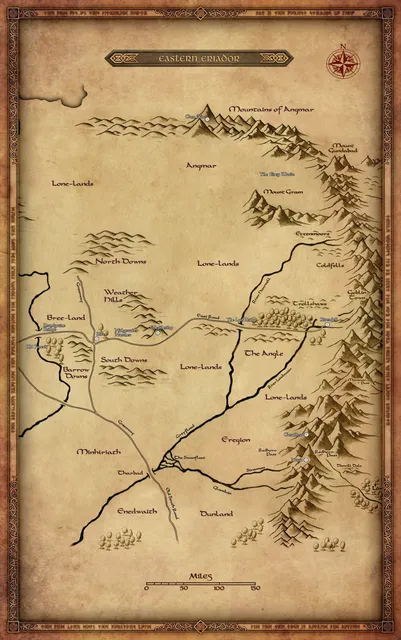
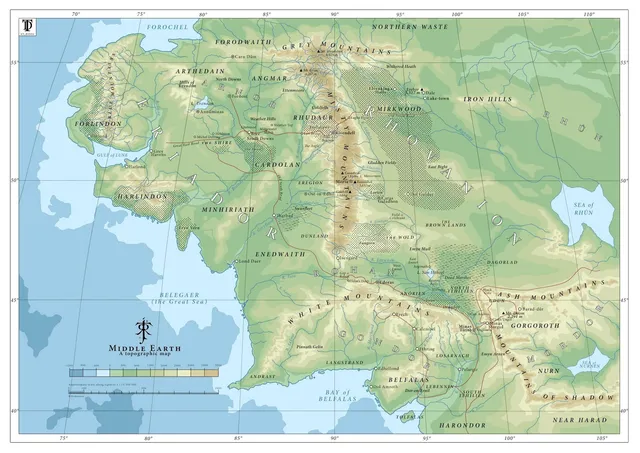
It lay in the central parts of the Misty Mountains, tunnelled and carved through the living rock of the mountains themselves. By the Second Age a traveller could pass through it from the west of the range to the east.
Layout
Khazad-dûm was a huge array of chambers, passages, mines, halls, stores and pits. In general, areas were either classed as the Mines of Moria or the city. The mines were the working sections of Khazad-dûm whilst the city contained the habitable parts. The city of Moria was located close to the eastern end of Moria. The distance from the west gate of Moria to the East-gate of Moria was at least forty miles.
The city areas of Khazad-dûm were located in the east. Old Moria, the oldest mansions and passages, were located close to the Great Gates. The North end was the part of Moria that had been excavated north of the older halls and the Great Gates and included the twenty first hall and the Chamber of Mazarbul with the tomb of Balin. They were structured into seven Levels and seven Deeps. The Levels stretched above the Great Gates with the First Level being on the same level as the Great Gates whilst the Deeps were set deeper within the mountain below the level of the Great Gates with the First Deep being immediately below the Great Gates. The First Deep included the Second Hall, which was no more than a quarter of a mile from the East-gate and a part of Old Moria. The eastern end was the part of Moria, which was just west of the East-gate. The First Hall was located on the same level as the East-gate and had high windows on its eastern side, which allowed bright daylight to illuminate the hall. Immediately to the east of the hall was the East-gate.
The eastern section of the city spaces had also been delved in such a manner as to have light shafts to illuminate their chambers. One example of this is the Chamber of Mazarbul which was located on the eastern edge of the Seventh Level.
The mine areas of Khazad-dûm were interlaced with the city spaces, but spread also westward toward the Doors of Durin. The mines ran deeper and further than any other tunnels within Khazad-dûm, and it is possible that more of the lower Deeps were given over to mining, although this is only conjecture.
The defined change between mines and city can be seen when the Fellowship pass through Moria - there is a marked difference between the early passages and chambers and those of the city structures illuminated by Gandalf.
Far below Moria, there are abysses, spaces and tunnels not known even by the Dwarves, but known by the Balrog. Nameless things gnaw the earth and make them, far from the knowledge of any lore.
Description
Maps
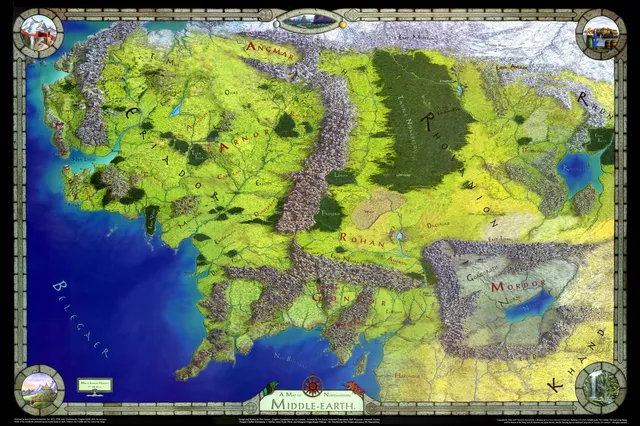


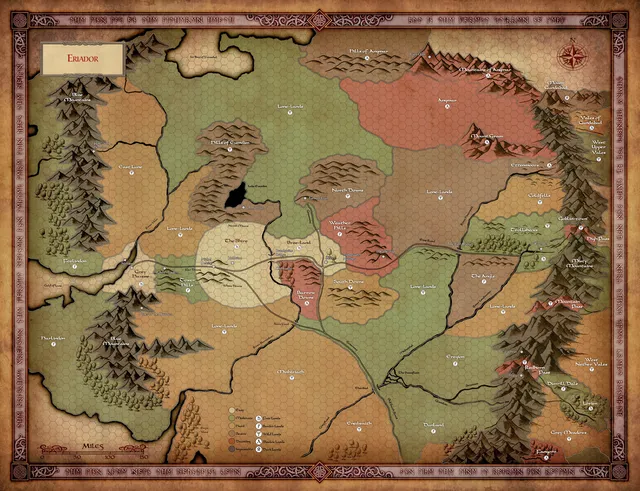
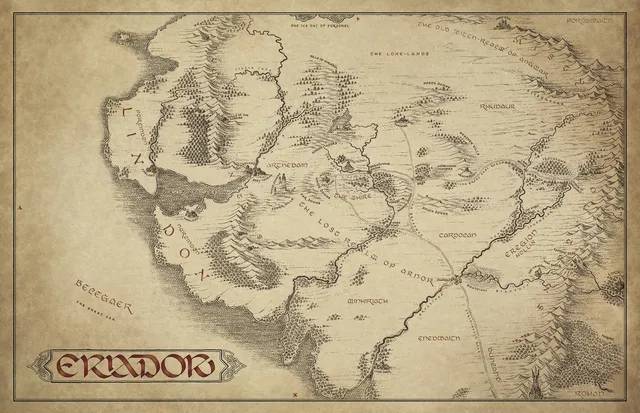
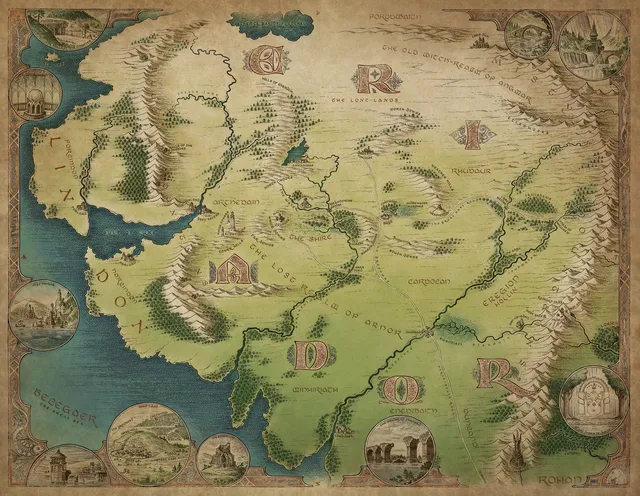



Elder Days
It was founded in very ancient days by Durin who awoke at Mount Gundabad in the Misty Mountains. He came upon the valley Azanulbizar beneath the mountains. He looked into a shimmering lake and saw a crown of stars reflected in its waters. He named that lake Kheled-zâram, the Mirrormere and it remained a revered place among Dwarves of all houses ever afterwards, and the Durin's Stone was erected on the location of that event.
There, in the caves above, Durin and his people started the delving and building of the Great Gates of Khazad-dûm, and the First Hall leading to a bridge over a chasm. From there began the expansion, both to Levels above and to Deeps below, and mines expanding out from the inhabited areas of the city proper.
As the centuries passed, the realm of Durin became the greatest of all their mansions, and became famous even to the distant west; the Elves of Beleriand, heard its rumour from the Dwarves of the Blue Mountains on their borders.
Durin the Deathless died before the end of the First Age, and was buried in a tomb in Khazad-dûm and his descendants continued to rule.
Second Age
In c. S.A. 40, most of the Dwarves of the Blue Mountains began leaving en masse from their now ruined cities for Khazad-dûm. The city was enriched not just in numbers, but in the western Houses' skills in smithing, crafting and masonry. All these factors created a renaissance for Khazad-dûm, and brought its prosperity to its zenith.
Khazad-dûm had expanded so much that it completely traversed the Mountains from east to west, ending to the western rocky cliffs at their base, the Walls of Moria. Narvi with the Lord of Eregion, Celebrimbor, constructed the magical West-gate of Moria.
The friendship of Khazad-dûm and Eregion came to a sudden end, however, in S.A. 1697. Sauron overran the country of the Elves. Durin's warriors withdrew from the Gates, and they shut them against Sauron, also secluding the kingdom off from the outside world.
It was also during this time that the Orcs reinvaded the mountains and made war on the Dwarves, taking Mount Gundabad from the Kingdom of Durin.
Third Age
Demise
Most of its great wealth was based on the rare Mithril that was found in its mines, and as the centuries passed, the Dwarves mined deeper and deeper for the precious metal. In the year T.A. 1980, their deep digging unleashed a nameless terror, a Balrog from the Elder Days, that wreaked dreadful destruction, and in slaying the King, Durin VI, became known as Durin's Bane. In the following year, Durin's son, Náin I, was also lost, and the Dwarves fled their ancient home.
After millennia as one of the richest cities in Middle-earth, Khazad-dûm stood dark and empty, but for the brooding menace the Dwarves had released. In that time it was given a new name, Moria, the Black Pit.
The monster - a Balrog of Morgoth, as was later known - lurked alone in Moria for nearly five hundred years. After that time, around T.A. 2480 Orcs made secret strongholds in the Mountains and Sauron started to populate the old city of Khazad-dûm with his creatures. Orcs from the North began to enter the abandoned city to raid its treasuries, and occupy it. Though the orcs' numbers were greatly reduced in the Battle of Nanduhirion, fought in the valley beneath Moria's East-gate in 2799, the Balrog could not be bested, and Khazad-dûm remained a place of darkness.
At some point between 2845 and 2850 the Wizard Gandalf entered the city looking for King Thráin II who had disappeared on journey to Erebor.
Balin's Colony
In 2989, there was an attempt by the Longbeards to reclaim their ancient home. The expedition was led by Balin, who had accompanied Bilbo Baggins on the Quest of Erebor. He led a colony of Dwarves there from Erebor. The Colony was successful at first, killing a considerable number of Orcs, taking many of the Eastern halls and finding many lost treasures such as Durin's Axe. They were however defeated and slain by the Orcs in 2994.
At some point either before or after the colony, Aragorn, Chieftain of the Dúnedain, entered Moria for some unknown purpose.
The Fellowship's passage
When Frodo Baggins set out from Rivendell with the Fellowship, they at first planned to travel over the Misty Mountains. When they were stopped by heavy snow on Mount Caradhras, they found themselves pursued by wolves and Orcs, and fled into Moria, so as to go under the mountains. There, they found Balin's journal in the Book of Mazarbul and learned the fate of his expedition. They were then set upon by a host of Trolls and Orcs, and they discovered that the terror was, in fact, a Balrog of Morgoth. Gandalf fought the Balrog on a narrow bridge and succeeded in destroying a section of bridge to make the Balrog fall. As it fell, the Balrog snagged Gandalf's leg with its whip of thongs and pulled him after it, sending them both plunging into the abyss spanned by the bridge. The rest of the Fellowship managed to escape Moria and reach Lórien mostly unharmed.
Unknown to the Fellowship, both Gandalf and the Balrog survived the fall and fought a ferocious battle from the depths of Moria to the mountains above, demolishing the top of the legendary Endless Stair and a part of the surrounding mountain peak in the process. Gandalf cast down the Balrog upon the mountainside and lived just long enough to see it die, but his story was not yet ended.
While Gandalf had felled the Balrog, Moria remained a place of evil creatures until the Fourth Age.
Later history
Though little information is given, the retaking of Khazad-dûm by Durin VII seems to have occurred sometime after Fo.A. 171. As the King of Durin's Folk, he led a final return to the city. He was successful; the House of Durin reclaimed their inheritance and the hammers rang again in their great halls beneath the Misty Mountains until the race of Dwarves ended.
Artwork
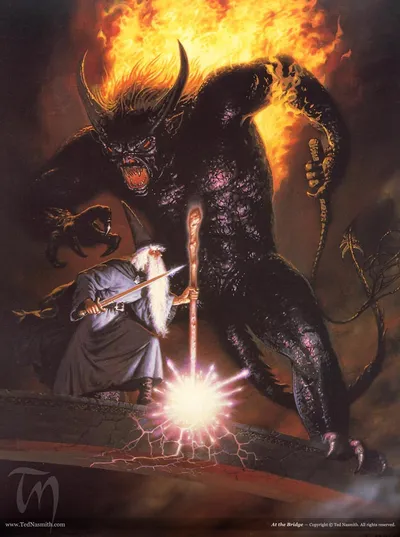
At the Bridge
Ted Nasmith
Battle for Moria
Justin Gerard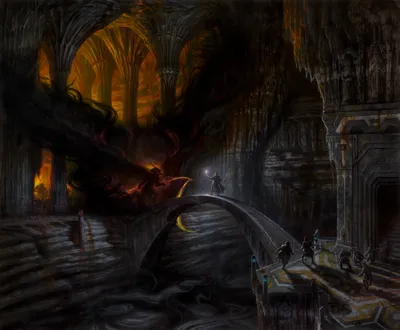
Bridge of Khazad-dum
Donato Giancola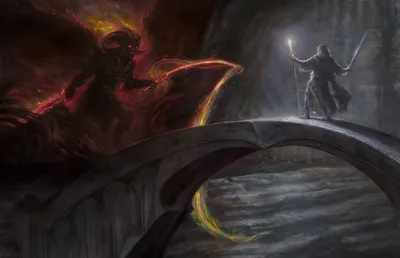
Bridge of Khazad-dum Detail Gandalf Balrog
Donato Giancola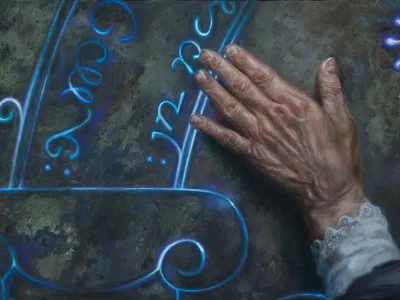
Doors of Moria
Donato Giancola
Fellowship in Moria
Donato Giancola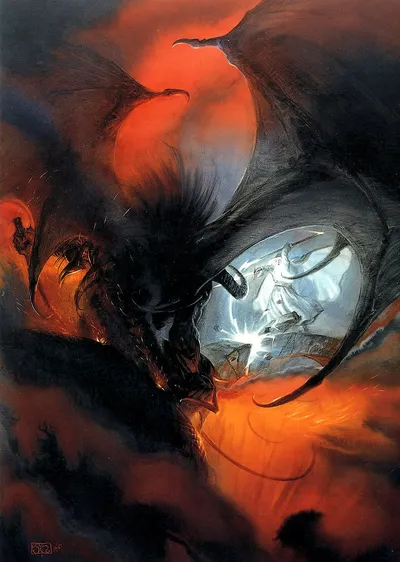
Gandalf and the Balrog
John Howe
Mines of Moria
Lucas Terryn
Moria Gate
Ted Nasmith
Password Into Moria
Ted Nasmith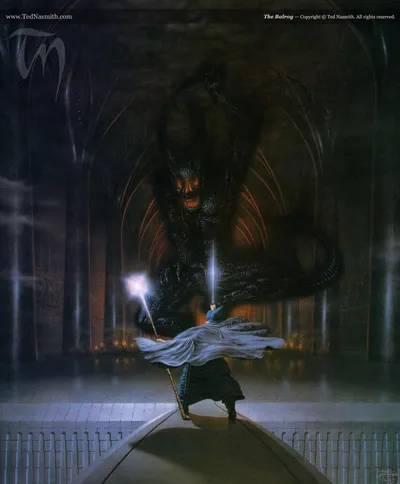
The Balrog
Ted Nasmith
The Doors of Durin
Darrell K. Sweet
The Fellowship Approaches Moria
Ted Nasmith