Gondolin was a city in Beleriand founded by Turgon which became the home of his people for most of the late First Age.
Some years after the Exile of the Noldor, Turgon was guided by Ulmo to the hidden valley of Tumladen, and there he founded Gondolin. Turgon's people, who had previously dwelt in Nevrast, travelled there secretly, becoming the Gondolindrim. Also known as the Hidden City, it was concealed from friend and foe alike by the Encircling Mountains, and guarded against trespassers by the Eagles of Thorondor.
The city remained hidden for nearly four hundred years, becoming the last Elven realm to endure against Morgoth, before it was finally discovered through the treachery of Maeglin and besieged. Turgon was lost in the Fall of the city, but some few escaped the destruction and dwelt as Exiles at the Mouths of Sirion.
Legacy
Ages later, some legendary weapons of Gondolin were found by Thorin and Company in a Trolls' lair. Elrond recognized them and explained that they ended up there after being plundered by dragons or goblins. Even in the Third Age, some orcs of the Misty Mountains knew of the legendary sword of Turgon, remembering how the Elves of Gondolin killed hundreds of goblins before their walls.
The realm would be mentioned by Elrond during his Council, and remembered by Galadriel, and also sung in Dwarven lore.


Building
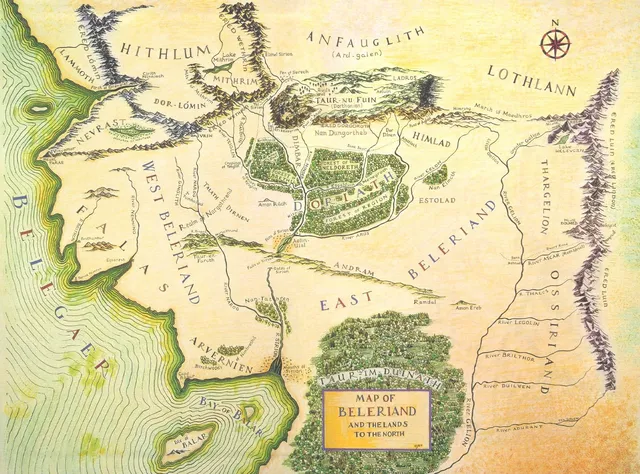
The round valley of Tumladen, within the Encircling Mountains, had originally been a lake, and in its centre stood a hill that had once been an island: Amon Gwareth. The valley had been emptied a long time before through the Dry River, creating the only entrance to the valley: the secret path of Orfalch Echor.
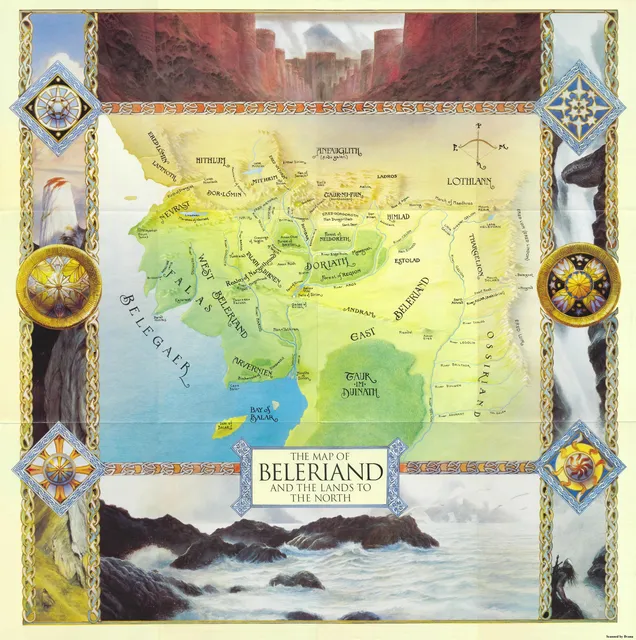
In F.A. 50, Turgon left Nevrast and travelled with his cousin Finrod southward through Beleriand. While they were resting in the Meres of Twilight, Ulmo came to them and laid upon them a deep sleep and disturbing dreams. Neither told the other about his dreams, but both cousins began a search for hidden places in case Morgoth broke the Siege of Angband. Soon, Finrod found the place where he would build his realm: Nargothrond; but Turgon did not, so he came back to Nevrast. Three years later, the Lord of Waters appeared to Turgon upon the shores and commanded him to travel forth alone. Guided by the Vala, Turgon found the valley of Tumladen and decided to found his city upon Amon Gwareth, as a memorial to Tirion upon Túna. However, he came first back to Nevrast, where he planned the building of his city.
After the Dagor Aglareb, in F.A. 64, Turgon felt unquiet again, and taking the most skilled of his people he went in secret to the hidden vale, and the first building of the city was begun. A watch was set around it, but the power of Ulmo also protected them. During the next fifty-two years, Turgon dwelt mostly in Nevrast, until the city was completed. Then he gave his city the name Ondolindë in Quenya, the "Rock of the Music of Water", because of the fountains of Amon Gwareth. In Sindarin this was rendered Gondolin, the "Hidden Rock". In F.A. 116, before leaving Vinyamar, Ulmo appeared to Turgon once more and told him:
Now thou shalt go at last to Gondolin, Turgon; and I will maintain my power in the Vale of Sirion, and in all the waters therein, so that none shall mark thy going, nor shall any find there the hidden entrance against thy will. Longest of all the realms of the Eldalië shall Gondolin stand against Melkor. [...] Thus it may come to pass that the curse of the Noldor shall find thee too ere the end, and treason awake within thy walls. Then they shall be in peril of fire. But if this peril draweth nigh indeed, then even from Nevrast one shall come to warn thee...
The people of Turgon were a third part of Fingolfin's followers and native Sindar of Nevrast, and they travelled from Nevrast and secretly entered the valley of Tumladen in discreet companies. After their arrival in the new city, the Gondolindrim continued to labour in its building, until it was said to rival even Tirion itself. Its walls stood high and shone white above the plain, and its most prominent feature was the great Tower of the King, where, among the fountains, Turgon himself made Glingal and Belthil, trees of gold and silver, in memory of the Two Trees of Valinor.
Coming of Maeglin
There followed the two centuries of the Long Peace: Morgoth was besieged in the far north of the world, and the people of Gondolin lived undisturbed by the events outside their valley. However, a seed of discontent appeared: in F.A. 316, Turgon's sister Aredhel became tired of her limited life in the valley and was determined to leave the city, much against Turgon's wishes, and journey into Beleriand. However, she was lost outside and Gondolin fell into sorrow for many years.
More than eighty years later, in F.A. 400, suddenly Aredhel returned with Maeglin, her son by Eöl the Dark Elf. Maeglin was enamoured of the city and Turgon welcomed him. But Eöl had followed his wife and son to Gondolin and was captured at the entranceway. He was brought before Turgon, and it was explained to him that the law of Gondolin did not allow any visitor to leave. Eöl refused to submit to Turgon's authority and instead chose death for himself and his unwilling son. He threw a poisoned dart to slay Maeglin, but it instead struck Aredhel, who fell ill with the poison and died. The body of Eöl was thrown off the Caragdûr for this offense.
Maeglin, however, had taken no part in these evils, and Turgon accepted him into the city. With time Maeglin grew to be among the lords of the Gondolindrim. "Thus it was in Gondolin; and amid all the bliss of that realm, while its glory lasted, a dark seed of evil was sown".
Two great battles
When Morgoth broke the Siege of Angband in the Dagor Bragollach, the people of Gondolin did not take part in any of its conflicts. However, in F.A. 458, they were drawn into the events of those years, when two young brothers of the race of Men, Húrin and Huor, were cut off from their army and became lost amid the feet of the Crissaegrim. Thorondor brought them to Turgon's city. At the bidding of Ulmo, Turgon accepted them, and they remained in Gondolin for almost a year. Although the law of Gondolin did not allow any visitor to leave, Turgon made an exception and allowed them to return to their homes. Both brothers kept the promise of not telling anyone where they had been, but other Men could deduce it, and soon a rumour was spread that reached Morgoth's servants.
Some years later, Beren and Lúthien were saved by the Eagles, and flying south, Lúthien could see far below, as a white light starting from a green jewel, the radiance of Gondolin the fair. But Lúthien wept because her beloved was mortally wounded.
But it is said in song that her tears falling from on high as she passed came like silver raindrops on the plain, and there a fountain sprang to life: the Fountain of Tinúviel, Eithel Nínui, most healing water until it withered in the flame.
Encirclement
As the Elves of Beleriand began to prepare for a counterstrike to the Dagor Bragollach, Turgon secretly began his own preparations and sent some forces to the Nirnaeth Arnoediad, where they were helped by the House of Hador. The only survivor thereof was Húrin, who was captured. Morgoth had great fear of Turgon, who was now High King of the Noldor, and wished to destroy him more than any other enemy. Therefore, the Dark Lord tortured Húrin and offered him freedom, but he could not make him reveal the location of Gondolin.
After returning from the Nirnaeth, Maeglin built the Gate of Steel, the last of the Seven Gates of Gondolin.
In F.A. 495, Ulmo appeared to Tuor and explained to him that the Curse of Mandos was coming to its fulfilment, but a chance still remained to avoid Doom upon Turgon and his people. Thus, Tuor was guided to the Hidden City by Voronwë, one of the mariners sent by Turgon to the West, who had survived a shipwreck. Ulmo's warning was that Turgon must abandon the city and seek the sea. Turgon, because of his pride and his love for his city, decided to ignore this warning. Tuor, however, was welcomed in the city by all save Maeglin. In later years, Tuor and Idril, the King's daughter, married and had a son: Eärendil.
Despite rejecting the warning, Turgon felt unrest, remembering the Doom of Mandos and fearing treason. So he ordered the Gates of the Mountains to be closed and he forbade anyone to leave the city, be it for peace or war.
The first great blow to the security of Gondolin came by accident. Húrin, who had been held captive by Morgoth, was released to wander in the world. In F.A. 501, he came to the edge of the Encircling Mountains, hoping to find the secret way to Gondolin. But the Way of Escape was closed, the Dry River blocked and the doors buried. Thorondor himself informed Turgon of the presence of Húrin. The King saw it as a bad omen and, fearing what Morgoth might have done to Húrin, withheld rescue. On further consideration, Turgon changed his mind, but it was too late. Húrin, seeing nothing, cried out in a loud voice "Turgon, Turgon, remember the Fen of Serech! O Turgon, will you not hear in your hidden halls?". Thus Morgoth learned the general area in which Gondolin lay, for his spies were watching this. Húrin turned away, broken and bitter.
In F.A. 507, Doriath fell, and Gondolin became the last Elven realm enduring against the power of Morgoth. Thorondor informed Turgon of the falls of Nargothrond and Doriath, but Turgon did not act, and swore he would never fight on the side of the Sons of Fëanor.
Fall
In the years following Húrin's revealing of Gondolin's region, Morgoth increased his search in the lands between the river Sirion and Anach. However, his spies and creatures could not do much due to the protection of the Eagles. Meanwhile, in Gondolin there was peace, and none knew that the kingdom was encircled by the Enemy save Idril, who felt dark forebodings in her heart. She ordered the construction of an escape tunnel that led to the plain in the northern part of the city. Only a few were informed of this way, and she asked that Maeglin hear nothing about it.
In F.A. 509, Maeglin, disobeying Turgon's laws, strayed too far from the city while searching for ore. There he was captured by Orcs and taken to Angband. Daunted by tortures, Maeglin bought his life in exchange for betraying Gondolin, motivated also by his hatred for Tuor and the desire for Idril. Therefore he gave Morgoth the exact location of the city, and the ways by which it could be reached and attacked. Morgoth felt very pleased, and promised to give him the hand of Idril, and make him lord of Gondolin under his vassalage; this was considered the worst treason of the Elder Days. Maeglin was released to avoid suspicion and to make an inside attack when the moment came.
The next year, when Eärendil was seven years old, Morgoth was prepared and sent a massive army, composed of Balrogs, Orcs, Wolves and Dragons. They crossed the northern part of the Echoriath, where the mountains were higher and therefore less guarded. In the city, the Gondolindrim were preparing for the Gates of Summer, a festival in which they welcomed the sunrise. But instead of seeing the light from the east, a red light appeared in the north. Nothing stopped the enemy until it reached the walls of the city, and the siege began.
There was a great siege, during which the captains of the noble houses and their warriors fell. The Tower of the King was defended, but it fell with great ruin and King Turgon died there. Meanwhile, attacking from the inside, Maeglin captured Idril and Eärendil, taking them to the walls. Tuor arrived in time to save them both, and after fighting Maeglin, threw him from the walls down into the flames.
Gathering as many of the people as they could find, Tuor and Idril escaped down their tunnel and led the Exiles of Gondolin at the Mouths of Sirion, where they mourned the loss of the White City.
Artwork

City of the Gondolindrim
Pete Amachree
Fall of Gondolin
Donato Giancola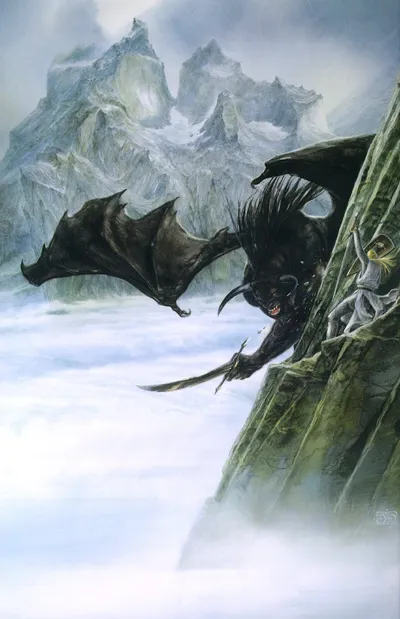
Glorfindel and the Balrog
John Howe
Gondolin
David Greset
Gondolin Huor and Hurin
Donato Giancola
Gondolin - The House of the Golden Flower
Pete Amachree
He Beheld a Vision of Gondolin Amid the Snow
Ted Nasmith
Morgoth's Forces before Gondolin
John Howe
Seventh Gate of Gondolin
David Greset
The Fall of Gondolin
Justin Gerard
The Sack of Gondolin
John Howe